.svg)

Read the article in Design World
By Sana Kazilbash | May 11, 2026
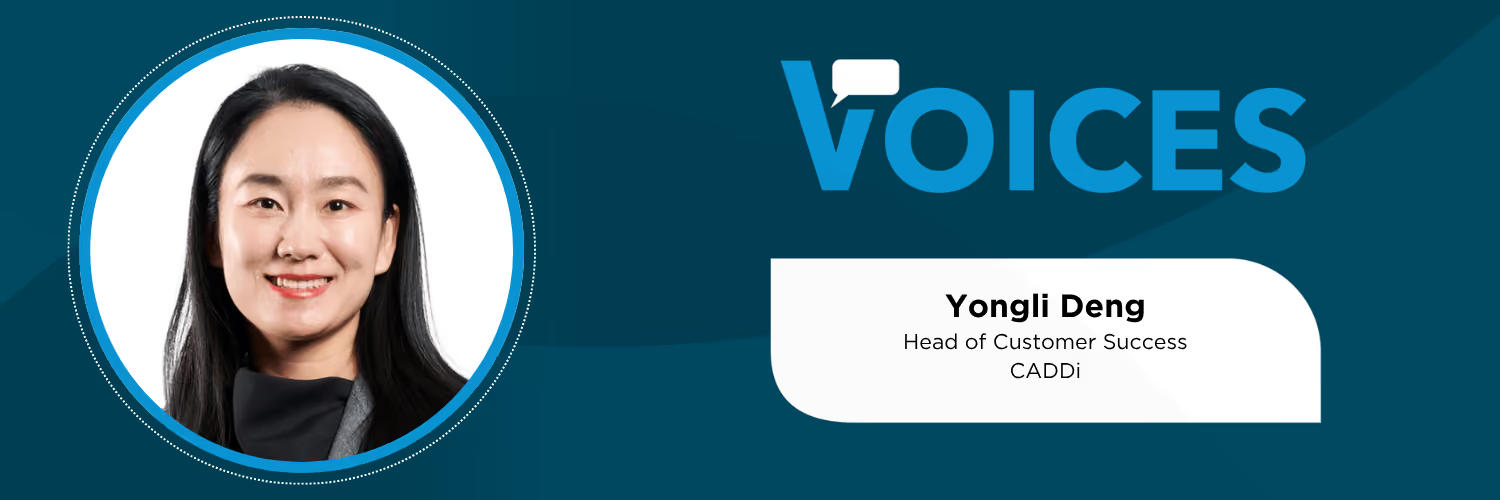
This article is sponsored by CADDi. In this Voices interview, Design World spoke with Yongli Deng, Head of Customer Success at CADDi, who shared a look at adoption of data intelligence tools, and the challenges and rewards of close partnerships and collaboration to drive a successful implementation.
Design World: Tell us about yourself and your role at CADDi.
Yongli Deng: I lead Customer Success for CADDi in the U.S. Since we’re a fast-growing startup, the work moves quickly and no two weeks look the same, which has been a fun challenge. I joined about eight months ago after spending eight years at Boston Consulting Group, and I made the move because I wanted to shift from advising companies to building alongside customers and driving real outcomes with them.
Looking back at the early adopters of data intelligence technology, we often see a disconnect between the department head’s grand AI vision and the daily reality of the engineers expected to use the technology. As an adviser who steps in post-sale to manage expectations, what is the most critical step accountable leaders must take to bridge this gap and ensure the platform gets adopted?
I think there are three main points.
The most important element for success is to work together as one team in a partnership with our customer, rather than just the implementation of a software or a tool. CADDi brings our product, our expertise, our change management experience, our technical support. Our customers bring their data access, time, champions and leadership reinforcement to help us really drive success. It’s important, too, for the customer to name one single accountable project owner for the success of the CADDi implementation.
Second, there’s often a gap between how users perceive and expect to use the technology, and the company’s vision. Executives talk about outcomes; what they care about is revenue or cost, and bottom-line improvement. But engineers are users that live in steps. The CADDi team helps translate that vision into day-to-day workflows the engineering team can understand and benefit from. We work together with the customer to define success by addressing both the management agenda and the ultimate benefit to the users — faster decision making, different use cases, standardized parts and reduced costs, for example.
And lastly, it’s important for CADDi to be honest and transparent with our customers about what we can and what we cannot do. Adoption gets killed when the expectations are vague or magical, or because users get frustrated early on, and it’s very common because AI is a buzzword, people get excited and then they expect AI to do everything to solve their problem. So, during our onboarding process we educate our customers about what AI can do and cannot do.
Some manufacturers’ teams initially adopt an AI platform simply to save on administrative and search time. However, high software login usage doesn’t automatically mean the business is seeing true value. When advising first-movers, how do you guide them past that ‘digital filing cabinet’ mindset to track specific, measurable outcomes — like increased decision velocity or procurement cost reductions?
This is critical, specifically for our business. We do not want customers to just see us as a search platform. But search time is tangible, and users can feel the difference immediately when they start using CADDi Drawer. If we don’t intentionally educate our customers, they tend to think that search time is where CADDi’s value comes from. But our value is in how many problems we can help our customers to solve.
For us to educate our customers about CADDi’s value, we spend time understanding their business, their team, and their processes. Then the CADDi team helps them come up with ideas and share inspiration, presenting real examples where CADDi can create value for them — not just reducing search time, but also contributing to their financial improvement or breaking silos across functions.
Ultimately, all this education is necessary because CADDi Drawer and our platform is first to market. There wasn’t a comparable product existing in this market before, so customers may not know what to expect. It’s easy for them to think, CADDi is just a search platform. In reality, we’re not just about search. We’re here to be a partner who can create value.
The manufacturing industry is currently facing a massive skilled labor shortage and the loss of ‘tribal knowledge’ as veteran engineers retire. You have mentioned that a key metric for CADDi’s success is ‘better onboarding and employee support.’ How do you help companies utilize their historical data to actually accelerate new-hire training and capture that expertise before it leaves the building?
When we onboard our customers, it’s common for the new hires to become the power users the fastest because they don’t have 10 years of muscle memory to unlearn. But they also don’t have access to all that expertise because they are so new, and without CADDi, they would have to ask a more experienced member for help, either through training, hand-holding, or learning by doing. Our platform helps reduce the barrier of “I don’t know who to ask.”
One way we help keep knowledge within the organization is by structuring historical data into onboarding workflows. CADDi is a platform that consolidates drawings and drawing-related documents, information and data into one place so it’s easy for people to gain access to all the information that they need. During the onboarding process, we help new members see us as the first stop when they need a reference, or have a question.
At one recent manufacturer we worked with, the VP of Engineering was hiring multiple engineers, and shared that he used their CADDi partnership as a talking point to attract young engineers to his organization. Not all manufacturers are adopting AI as CADDi does, so he used this to signal his company is modern, serious about engineering excellence, and at the forefront of adopting AI in the engineering design world.
When deploying complex intelligence platforms, a buyer’s initial expectations rarely match the immediate reality of the rollout. Looking back at the implementations your team has successfully turned around, why is a deeply consultative, “co-building” partnership more critical for ensuring long-term ROI than just relying on standard IT tech support?
In this era of AI, everyone is excited about it, using it and building pilots. The barrier to build a tool yourself in-house is a lot lower. So increasingly often, the customer will not just want to pay for a tool, they want to pay for impact. For us to overcome the natural inclination to build in-house, we need to provide impact that transcends what their IT department would be able to implement.
For us to deliver impact requires, first, that CADDi’s implementation be closely tied to customers’ strategic agenda. Otherwise, it won’t be prioritized, and the impact will be non-existent or minimal to their business.
Second, the foundation of creating value is adoption, and driving that adoption requires collaboration between CADDi and our customers. A lot of manufacturers have used the same tools or same processes for years. It’s understandable, because there’s a very low tolerance for making mistakes in the manufacturing process. Imagine you send the wrong version of your drawing to your supplier or your customer. The cost of that mistake can be massive.
To build the necessary momentum for change, our customers typically put a mandate in place to get through the harder part, which is going from zero to adoption. After that, our customers continue encouraging their users for adoption, while CADDi is here to help drive that change, to do training, share best practices, and come up with creative ideas like sending newsletters, creating champions, doing on-site training or office hours.
Third, delivering value beyond adoption requires shaping our implementation to make sure it is aligned with our customers’ strategic goals, and ensuring we have aligned and defined the success criteria at the beginning of the project. It’s very much a partnership.
For some real-life examples, walk us through how your team acted as a strategic adviser during a successful vs. challenging implementation, and explain why unifying multiple teams onto a CADDi-supported workflow drove tangible ROI from the POV of different key stakeholders.
We recently published a case study on a successful integration with Amerequip. We are in the second quarter of their implementation, which is still early, but we have already provided strong value to the customer. They were skeptical of CADDi’s value proposition at first, and whether they could justify the ROI. I led this project myself with the CS team, and once we started the partnership with them we dedicated one resource to sit down with them to understand their needs, their pain points and their data, to co-design the environment and workflow with them, to educate them about our platform.
During onboarding, we are not just implementing a tool, we are also helping our customers to prioritize. Customers will have lots of ideas. My role and my team’s role in this process is not just taking customers’ requests and implementing them. Instead, we actively help our customers to prioritize what’s most important and what’s less important, to build a roadmap for our implementation.
Lastly, we’re building credibility through little actions, like recurring weekly check-ins and making sure every meeting has a clear agenda, clear outcome, clear action items. Even with something we needed to deprioritize, a few weeks later our team is proactively coming back to the customer saying, this was something we discussed a few weeks ago, now it’s time to bring that back to our agenda. We’re not letting anything fall through.
We have been very transparent with Amerequip in terms of what we can and cannot do. Customers really appreciate that honesty and transparency. It helps them understand our capabilities, and also builds trust and credibility with them. Now Amerequip is connecting us to other companies in the area, and attending our workshops to help our other customers.
A challenging implementation was with an American manufacturer who initially expected CADDi to deliver a function we’re not capable of. There was some miscommunication, and the customer expected us to do something different, which made the initial implementation very challenging because the customer was frustrated we couldn’t deliver what they initially asked for.
But our CS team proactively helped guide the customer by sharing other relevant use cases with them, and redefining workflows that we later realized are even more connected to their goal of improving their quotation win rates and quotation speed. A year later, this customer became another champion of CADDi. They came to our customer event and shared their experience of this journey with other customers. It’s very inspiring to see that, when this customer was originally in a very challenging situation.
This is the value of CADDi’s strategic partnership and the critical role our Customer Success team plays. The partnership starts from the first touchpoint and deepens as customers implement new technologies. Driven by our unique customer focus and the vision of our CEO Yushiro Kato, CADDi operates more like a top-tier management consulting firm than a traditional SaaS development vendor.
Through a high-intensity, white-glove partnership model and manufacturing-exclusive AI data platform technology, CADDi helps manufacturers strengthen operational performance, reduce interoperability friction and build the unified data intelligence foundation needed for sustainable growth in American manufacturing.
To learn more about how CADDi AI platform first-movers are improving productivity by unlocking faster, smarter decisions, explore our collection of featured customer case studies at us.caddi.com/case-studies. Or read CADDi’s new white paper which explains how improving decision velocity can drive significant productivity gains without large capital investments, while also improving the quality of decisions.
.svg)
.svg)
.svg)

Related Resources

.avif)

.avif)


