
Unytite

Accelerating design for R&D teams at Unityte with CADDi

Case Study

Accelerating design for R&D teams at Unityte with CADDi

90
%
reduction in search time
42000
42000
drawings and documents organized
200
hours
saved in engineering and production
90
%
reduction in search time
42000
42000
drawings and documents organized
200
hours
saved in engineering and production
90
%
reduction in search time
200
hours
saved in engineering and production

Unytite

Established
1986
Number of Employees
Between 100 and 500
Sales
Business Activities
Manufacturing of bolts and nuts

Facebook Logo - Caddi Drawer - Drawing Search SoftwareTwitter Logo - Caddi Drawer - Drawing Search SoftwareLinkedIn Logo - Caddi Drawer - Drawing Search SoftwareEmail Icon - Caddi Drawer - Drawing Search Software

Before

Data was scattered across many systems, requiring long searches and reliance on knowledgeable individuals

After

Anyone can find any needed information quickly, searching in one central repository

Modern operational challenges at Unytite, Inc.

Since 1986, Unytite, Inc. has been recognized as a trusted U.S. manufacturer of high-quality structural fasteners and cold and hot formed components. The products support critical applications in infrastructure, heavy equipment, and automotive industries. With a strong reputation built on reliability, product quality, and disciplined manufacturing processes, Unytite’s US facility plays a critical role in supplying large volumes while meeting strict standards and ensuring full traceability.

However, as production demands grew and customer specifications became more detailed, Unytite encountered difficulties in how information was organized and accessed. In addition, Unytite also faced the difficulty of passing down technical manufacturing skills and knowledge to the next generation.

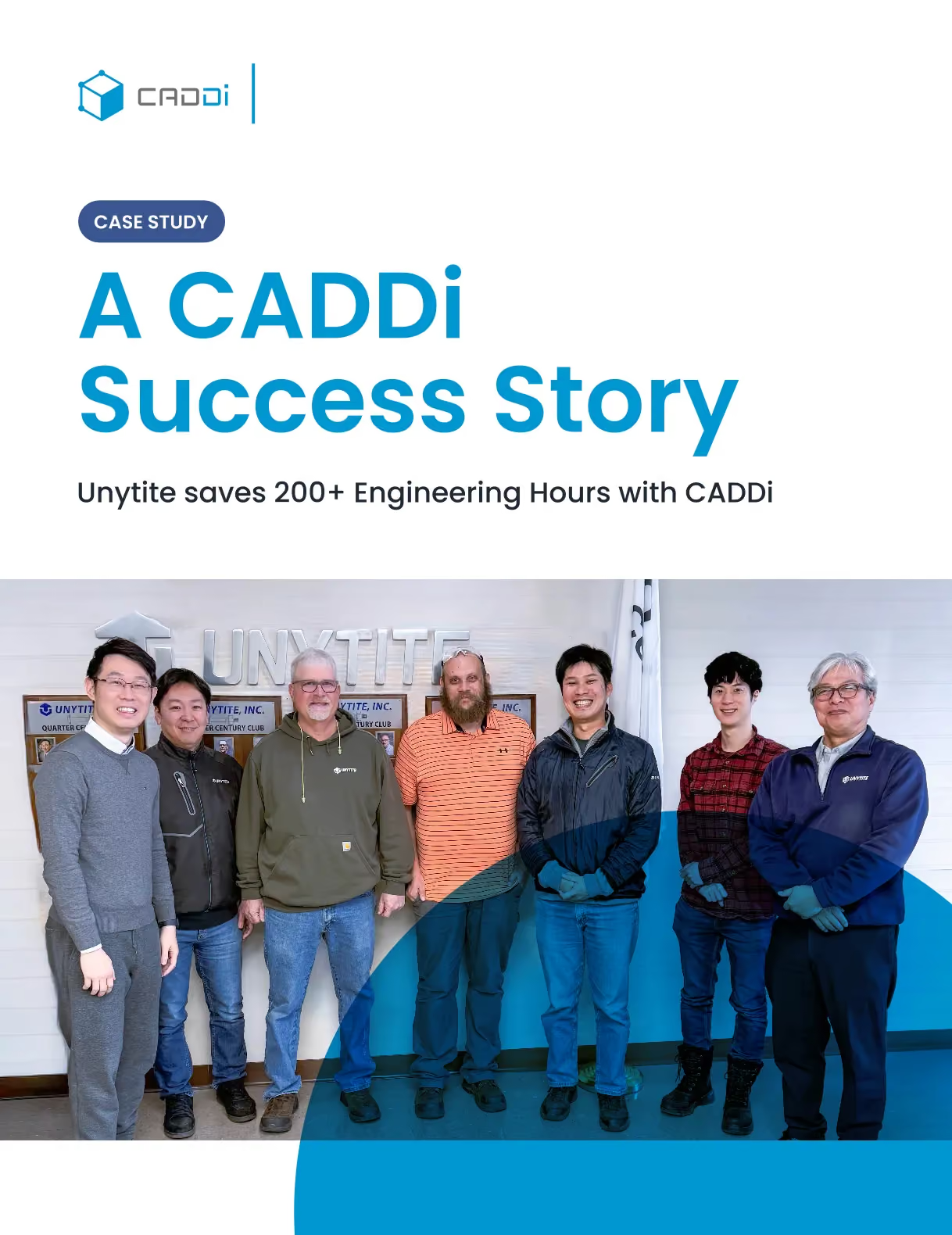
Members of the Unytite and CADDi teams during an onsite visit.

A production environment constrained by fragmented information

Key engineering, production, and quality data — drawings, check sheets, tooling instructions, routing sheets, quality alerts — were technically “available,” but scattered across decentralized storage locations and emails. As a result:

  • R&D engineers used an extensive amount of time to investigate how past quotation projects had been designed.

  • Quality engineers spent excessive time searching for past countermeasures, alerts, and customer feedback.

  • Sales and Production frequently lacked visibility into process routings, process notes, or customer specification changes.

  • Operational expertise was largely dependent on a few of the senior employees, which meant some activities stalled without them. This reduced efficiency and diverted their focus from high-value tasks.

Even with disciplined processes, critical information was scattered across multiple platforms, causing delays, inconsistencies, and added risk in a fast-paced production environment.

When quick, accurate decisions were required, information access turned into a critical constraint.

In situations requiring detailed analysis or process reviews, teams often need to take preliminary steps, including:

  • Cross-referencing customer drawings
  • Reviewing past alerts
  • Confirming previous corrective actions
  • Comparing revision histories

Instead of focusing on analysis, they spent valuable minutes — sometimes hours — simply locating the correct files.

Moreover, an internal survey at Unytite highlighted a recurring issue:

“I searched inside the internal network storage, ERP system, and emails. Only certain people know where the right documents are.” — Survey Respondent

This heavy reliance on specific individuals created obstacles, slowed reaction time, and hindered knowledge transfer.

Unlocking cross-functional efficiency with CADDi Drawer

Recognizing the need for a centralized, intelligent, and revision-safe information system, Unytite implemented CADDi Drawer across Production, Quality, Sales, and R&D.

The impact was immediate and transformative.

Centralizing all manufacturing knowledge in one searchable hub

Drawer unified more than 55,000 drawings, inspection sheets, routings, and customer specs under a consistent structure. Instead of navigating multiple systems, teams simply:

  • search by part name,
  • search by drawing number,
  • search by keywords such as “check sheet,” “problem control,” or “routing,”
  • or even use AI-powered similarity search to locate related components.

Turning individual knowledge into company-wide value

Building on a centralized and reliable drawing management foundation, Unytite further addressed a key challenge: knowledge being dependent on individuals rather than the organization.

By digitizing and centralizing past drawings, quotations, and quality records in Drawer, the following improvements were achieved:

  • Visualization of individual knowledge
    Past designs, estimates, and quality issues became visible and searchable for everyone, eliminating reliance on specific individuals.
  • Faster Sales proposals
    Sales teams can reference similar past products and propose dimensions and specifications more efficiently when discussing with new customers and products.
  • Reduced R&D and quotation effort
    R&D teams can quickly review past quotation studies and quality issue records, reducing evaluation time and quotation workload.

Beyond improving efficiency, these changes fundamentally transformed the way knowledge is shared within the organization.

Breaking dependency on specific individuals

By shifting from “tribal knowledge in people’s heads” to “institutional knowledge in Drawer,” Unytite has made critical information discoverable for anyone — including new employees.

“I used to ask senior members where files were stored. Now I just search Drawer.”
— Employee of the R&D Department

Unytite’s Achievements with CADDi

90%+ reduction in search time

Before CADDi, a typical drawing lookup would take 10 to 15 minutes. With CADDi, it takes less than one minute. With many instances of drawing searches per day, this quickly adds up to hundreds of engineering and production hours saved per year.

55,000+ documents centralized in a controlled, revision-safe structure

Rather than having data scattered across many different systems, CADDi allowed Unytite to centralize access to all their manufacturing data.

Faster quality response and RCA

Cross-referencing between customer drawings, alerts, and past countermeasures has become immediate, dramatically shortening investigation cycles.

Active adoption across departments

Production, Quality, Sales, and R&D teams consistently use Drawer for daily tasks, setting the groundwork for a unified digital workspace across the entire facility.

What’s Next: Accelerating data-driven manufacturing

Building on early success, Unytite and CADDi have aligned on the next stage of transformation. Unytite plans on expanding the usage of CADDi in three major areas:

Quote & Cost Integration via CADDi AI Data Platform

Combine Drawer drawings with:

  • PO history
  • Supplier pricing
  • Purchasing Management

This will support smarter quoting, vendor evaluation, and spend reduction.

AI Chat Search Implementation (conversational access to data)

Enable members to ask questions like:

  • “Show me similar drawings with 1’’ threads.”
    “What was the last Quality Alert for part XXXXX?”
  • “What materials meet that standard?”

A major step to enhance the quality level and democratize expert knowledge.

Japan–U.S. knowledge alignment with shared tenants

Unytite can standardize documentation management across regions and accelerate cross-plant learning.

In conclusion, CADDi Drawer is helping Unytite transition from isolated document storage to a unified, intelligence-driven manufacturing ecosystem.

By connecting design, production, quality, and cost data, Unytite is unlocking the speed, traceability, and efficiency required in fastener manufacturing.

Unytite reduced drawing search time by over 90% and built a unified, revision-controlled knowledge hub connecting production, quality, Sales, and R&D — setting the foundation for global, AI-driven operational excellence.

Ready to see CADDi Drawer in action? Get a personalized demo.

Book a Demo
This is some text inside of a div block.

Take this case study on-the-go

Download PDF Now

Accelerating design for R&D teams at Unityte with CADDi

Accelerating design for R&D teams at Unityte with CADDi

90%

reduction in search time

42,000

drawings and documents organized

200 hours

saved in engineering and production

90%

reduction in search time

42000

drawings and documents organized
Before

Data was scattered across many systems, requiring long searches and reliance on knowledgeable individuals

After

Anyone can find any needed information quickly, searching in one central repository

Modern operational challenges at Unytite, Inc.

Since 1986, Unytite, Inc. has been recognized as a trusted U.S. manufacturer of high-quality structural fasteners and cold and hot formed components. The products support critical applications in infrastructure, heavy equipment, and automotive industries. With a strong reputation built on reliability, product quality, and disciplined manufacturing processes, Unytite’s US facility plays a critical role in supplying large volumes while meeting strict standards and ensuring full traceability.

However, as production demands grew and customer specifications became more detailed, Unytite encountered difficulties in how information was organized and accessed. In addition, Unytite also faced the difficulty of passing down technical manufacturing skills and knowledge to the next generation.

Members of the Unytite and CADDi teams during an onsite visit.

A production environment constrained by fragmented information

Key engineering, production, and quality data — drawings, check sheets, tooling instructions, routing sheets, quality alerts — were technically “available,” but scattered across decentralized storage locations and emails. As a result:

  • R&D engineers used an extensive amount of time to investigate how past quotation projects had been designed.

  • Quality engineers spent excessive time searching for past countermeasures, alerts, and customer feedback.

  • Sales and Production frequently lacked visibility into process routings, process notes, or customer specification changes.

  • Operational expertise was largely dependent on a few of the senior employees, which meant some activities stalled without them. This reduced efficiency and diverted their focus from high-value tasks.

Even with disciplined processes, critical information was scattered across multiple platforms, causing delays, inconsistencies, and added risk in a fast-paced production environment.

When quick, accurate decisions were required, information access turned into a critical constraint.

In situations requiring detailed analysis or process reviews, teams often need to take preliminary steps, including:

  • Cross-referencing customer drawings
  • Reviewing past alerts
  • Confirming previous corrective actions
  • Comparing revision histories

Instead of focusing on analysis, they spent valuable minutes — sometimes hours — simply locating the correct files.

Moreover, an internal survey at Unytite highlighted a recurring issue:

“I searched inside the internal network storage, ERP system, and emails. Only certain people know where the right documents are.” — Survey Respondent

This heavy reliance on specific individuals created obstacles, slowed reaction time, and hindered knowledge transfer.

Unlocking cross-functional efficiency with CADDi Drawer

Recognizing the need for a centralized, intelligent, and revision-safe information system, Unytite implemented CADDi Drawer across Production, Quality, Sales, and R&D.

The impact was immediate and transformative.

Centralizing all manufacturing knowledge in one searchable hub

Drawer unified more than 55,000 drawings, inspection sheets, routings, and customer specs under a consistent structure. Instead of navigating multiple systems, teams simply:

  • search by part name,
  • search by drawing number,
  • search by keywords such as “check sheet,” “problem control,” or “routing,”
  • or even use AI-powered similarity search to locate related components.

Turning individual knowledge into company-wide value

Building on a centralized and reliable drawing management foundation, Unytite further addressed a key challenge: knowledge being dependent on individuals rather than the organization.

By digitizing and centralizing past drawings, quotations, and quality records in Drawer, the following improvements were achieved:

  • Visualization of individual knowledge
    Past designs, estimates, and quality issues became visible and searchable for everyone, eliminating reliance on specific individuals.
  • Faster Sales proposals
    Sales teams can reference similar past products and propose dimensions and specifications more efficiently when discussing with new customers and products.
  • Reduced R&D and quotation effort
    R&D teams can quickly review past quotation studies and quality issue records, reducing evaluation time and quotation workload.

Beyond improving efficiency, these changes fundamentally transformed the way knowledge is shared within the organization.

Breaking dependency on specific individuals

By shifting from “tribal knowledge in people’s heads” to “institutional knowledge in Drawer,” Unytite has made critical information discoverable for anyone — including new employees.

“I used to ask senior members where files were stored. Now I just search Drawer.”
— Employee of the R&D Department

Unytite’s Achievements with CADDi

90%+ reduction in search time

Before CADDi, a typical drawing lookup would take 10 to 15 minutes. With CADDi, it takes less than one minute. With many instances of drawing searches per day, this quickly adds up to hundreds of engineering and production hours saved per year.

55,000+ documents centralized in a controlled, revision-safe structure

Rather than having data scattered across many different systems, CADDi allowed Unytite to centralize access to all their manufacturing data.

Faster quality response and RCA

Cross-referencing between customer drawings, alerts, and past countermeasures has become immediate, dramatically shortening investigation cycles.

Active adoption across departments

Production, Quality, Sales, and R&D teams consistently use Drawer for daily tasks, setting the groundwork for a unified digital workspace across the entire facility.

What’s Next: Accelerating data-driven manufacturing

Building on early success, Unytite and CADDi have aligned on the next stage of transformation. Unytite plans on expanding the usage of CADDi in three major areas:

Quote & Cost Integration via CADDi AI Data Platform

Combine Drawer drawings with:

  • PO history
  • Supplier pricing
  • Purchasing Management

This will support smarter quoting, vendor evaluation, and spend reduction.

AI Chat Search Implementation (conversational access to data)

Enable members to ask questions like:

  • “Show me similar drawings with 1’’ threads.”
    “What was the last Quality Alert for part XXXXX?”
  • “What materials meet that standard?”

A major step to enhance the quality level and democratize expert knowledge.

Japan–U.S. knowledge alignment with shared tenants

Unytite can standardize documentation management across regions and accelerate cross-plant learning.

In conclusion, CADDi Drawer is helping Unytite transition from isolated document storage to a unified, intelligence-driven manufacturing ecosystem.

By connecting design, production, quality, and cost data, Unytite is unlocking the speed, traceability, and efficiency required in fastener manufacturing.

Unytite reduced drawing search time by over 90% and built a unified, revision-controlled knowledge hub connecting production, quality, Sales, and R&D — setting the foundation for global, AI-driven operational excellence.

Ready to see CADDi Drawer in action?
Get a personalized demo.

Book a Demo

Heading 1

Modern stumbling blocks for procurement

Heading 3

Heading 4

Heading 5
Heading 6

Since its founding in 1954, DCC Automation / Dairy Conveyor Corp. has become a trusted name in hygienic and performance-driven automation. The company designs and manufactures high-quality conveyor systems, robotic palletizers, custom control panels, and end-of-line packaging solutions. DCC’s Evolution Line featuring the Auto-Pack Caser, Round Bottle Caser, and Slant Caser demonstrates its commitment to precision, cleanliness, and flexibility. Each system is engineered to meet the diverse needs of today’s dairy, food, beverage, and household industries. With recent recognition such as the 2024 Rockwell Automation PartnerNetwork™ OEM Innovation Award, DCC Automation continues to redefine performance standards and drive progress across the global manufacturing landscape.


Their key projects, including palletizers and casers, often involved up to 800 separate line items, resulting in a lengthy procurement process. External factors further complicated this process, making efficiency a challenge. In the modern era of supply chain disruption and complexity, DCC recognized the need to re-evaluate their procurement costs. Factors such as geopolitical relations, ongoing and upcoming tariffs, and material shortages can make previously viable purchasing strategies less sustainable, prompting a strategic re-evaluation.


Unfortunately, making these new procurement strategic decisions requires a lot of experience and expertise. DCC found that the required knowledge was inadequately distributed among different teams, ending up in silos and known only by specific individuals. Existing data management structures, like ERP tools or Solidworks, made the data technically available, but not easily accessible. Different teams working in different systems had a hard time sharing insights and information.


On top of this, a specific initiative in one of DCC’s branches was to consolidate suppliers based on expertise. This is a complicated procurement initiative that requires a lot of manual cross-referencing and expertise – knowing where to find categories of component parts that are similar enough, and finding the ideal quality-price tradeoff point for each category. Processes such as these, that require specific experts to track down data, slow the entire company’s progress towards their goals by taking these people away from other valuable work. The most valuable procurement experts were being stretched too thin.

Block quote

Ordered list

  1. Item 1
  2. Item 2
  3. Item 3

Unordered list

  • Item A
  • Item B
  • Item C

Text link

Bold text

Emphasis

Superscript

Subscript

This is some text inside of a div block.

Don’t Miss Out!

Discover the secrets behind our customers’ success. Download our exclusive case study pdf before you go.
Button Text

Schedule a sales call

Fill out form: Step 1 of 2
Oops! Something went wrong while submitting the form.
Thank you! Your submission has been received.