.svg)

Removing the Friction: 5 Ways Design Engineers at Industrial Machinery OEMs Can Accelerate Time-to-Market


Table of Contents

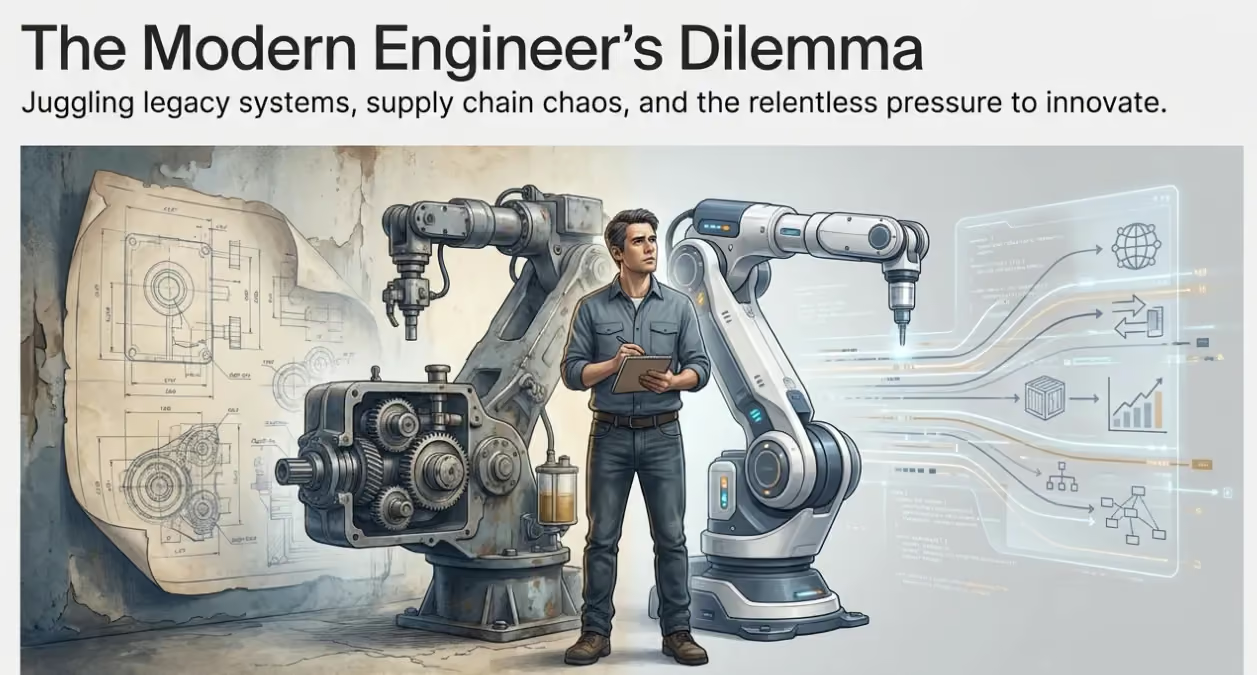
Design Engineers in the Industrial Machinery sector (NAICS 333) are the architects of physical reality, responsible for translating customer needs into complex, functional equipment. Yet, the modern reality of this role is less about pure creative design and more about administrative friction. Often serving as a "Functional Buffer" between theoretical R&D and the shop floor's physical constraints, designers spend a disproportionate amount of time navigating legacy Product Data Management (PDM) systems, manually reconciling fragmented data, and struggling with cross-functional conflict.
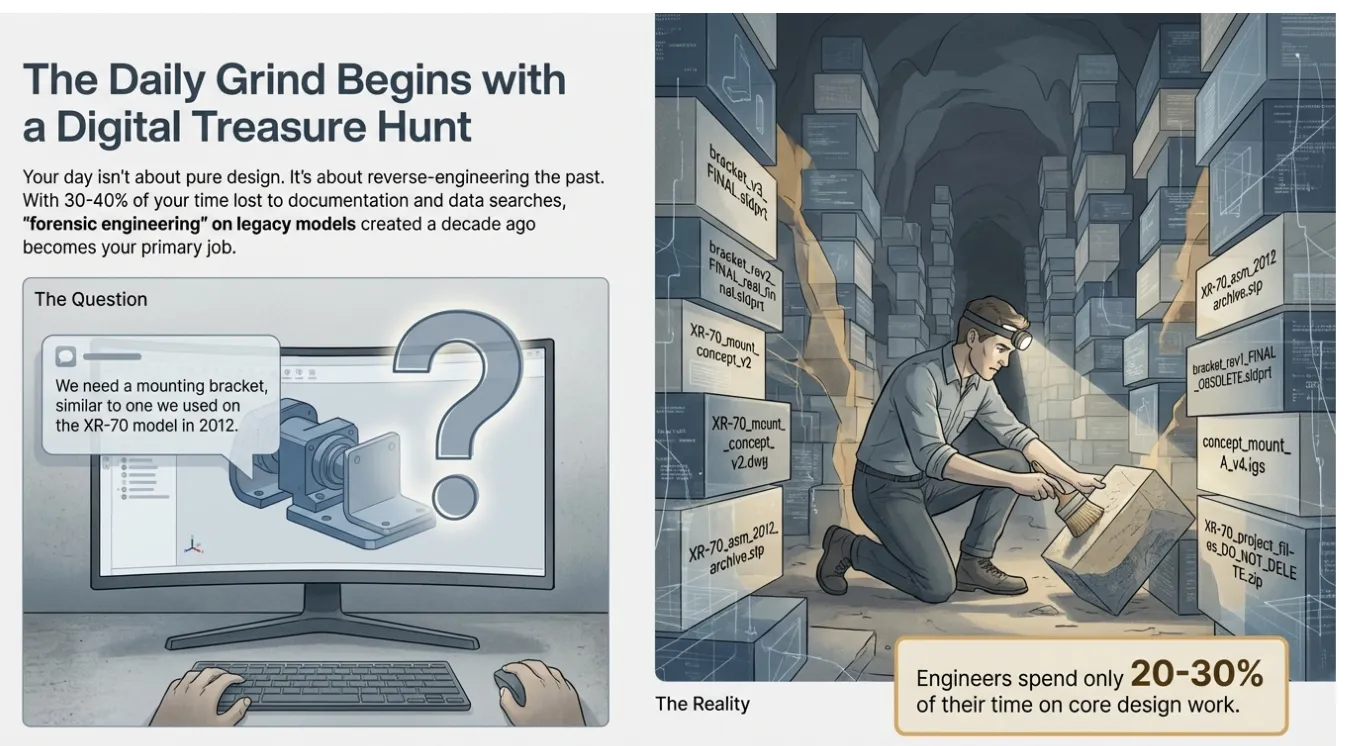
In today’s fast-paced environment—characterized by high-mix variability and intense pressure to increase speed to market—this administrative overhead is no longer sustainable. Core design work (CAD/FEA) is often reduced from an ideal 60% of an engineer's time to a mere 20-30% because hours are consumed by meetings, documentation (Engineering Change Orders or ECOs), and administrative PDM tasks.
By leveraging modern Manufacturing Intelligence solutions, design engineers can eliminate this friction, shifting their focus back to innovation and high-value strategic activities.
Here are five critical challenges facing Industrial Machinery Design Engineers and how CADDi, the AI data platform for manufacturing, helps solve them.
1. The Hidden Cost of Reinventing the Wheel
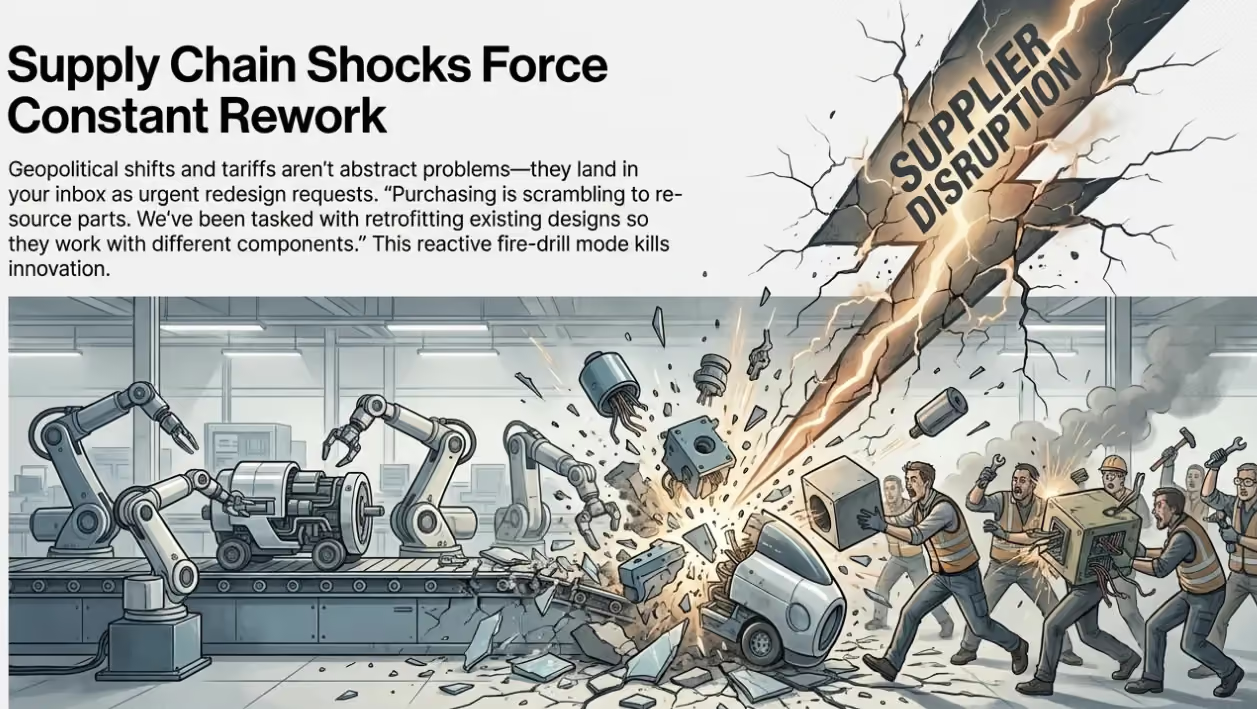
The Challenge: It is surprisingly common for engineers to spend time designing entirely new parts that are functionally identical or nearly identical to parts already manufactured or sourced in the past. This occurs because the time required to search for relevant prior designs in disorganized file systems or through limited traditional search methods makes it feel "faster to draw a new one than to search for a drawing". This duplication leads to rampant parts proliferation, ballooning procurement costs and inventory complexity.
Why It Matters Now: In a period where rising costs are the top concern for manufacturing leaders, reducing unnecessary component variations is a direct path to savings. Duplicative designs incur many unnecessary costs, including increased inventory management complexity and lost bulk purchasing opportunities.
How CADDi Helps: CADDi Drawer’s patented similarity search uses AI to analyze the geometric shape of a new design (even from a rough sketch or drawing) and instantly surfaces all similar parts previously engineered or purchased. This eliminates redundant work, enabling design reuse and standardization. Instead of starting from a blank screen, engineers start from a proven design, leading to a substantial reduction in design time and cutting engineering costs.
2. Bridging the Generational Knowledge Gap
The Challenge: Design Engineers function as a "Generational Buffer," bridging the expertise of retiring senior staff—who hold deep, "tribal knowledge" of machining and process constraints—with the digital requirements of newer teams. When veteran engineers retire, critical institutional knowledge about why a specific part was designed a certain way, or which suppliers failed to meet quality standards, is lost forever.
Why It Matters Now: The manufacturing sector faces a persistent talent shortage and a wave of veteran retirements. This knowledge drain slows new hire onboarding, often requiring new engineers to constantly interrupt senior staff for basic information, which taxes the entire department.
How CADDi Helps: CADDi functions as the organization’s "digital brain" or "digital mentor," democratizing institutional knowledge. By utilizing proprietary OCR-based AI technology, CADDi digitizes and extracts information from every drawing (including legacy 2D and handwritten notes) and links it with all historical procurement, quality, and supplier data. New hires can search intuitively using keywords or part shapes, bypassing the need to memorize arbitrary drawing numbers or interrupt senior staff, making them productive much faster.
3. Overcoming the PDM/PLM Search Bottleneck
The Challenge: While Product Data Management (PDM) systems are crucial "systems of record" for version control, their search capabilities are often limited. Legacy systems force engineers to rely on searching by specific file names or part IDs. This outdated methodology contributes to the infamous "check-in/check-out" wars and performance latency (the "spinning blue wheel") that halts assembly progress for minutes at a time.
Why It Matters Now: The inherent slowness and limitations of traditional search methods create data gaps. Engineers waste valuable time waiting for systems to respond or searching through irrelevant results. Efficient data retrieval is fundamental to keeping complex machinery development on schedule.
How CADDi Helps: CADDi Drawer acts as a powerful "System of Insight" that complements existing PLM/PDM systems. It aggregates data from systems like ERP, PLM, and CAD into a single data lake, ensuring that all information is searchable and connected. By moving beyond rigid file management, CADDi’s advanced search capabilities—including similarity search and keyword search based on drawing content—allows teams to retrieve design and related data in seconds, rather than minutes or hours, thus directly mitigating the PDM-related friction.
4. Integrating Design for Manufacturability (DFM) with Cost Data
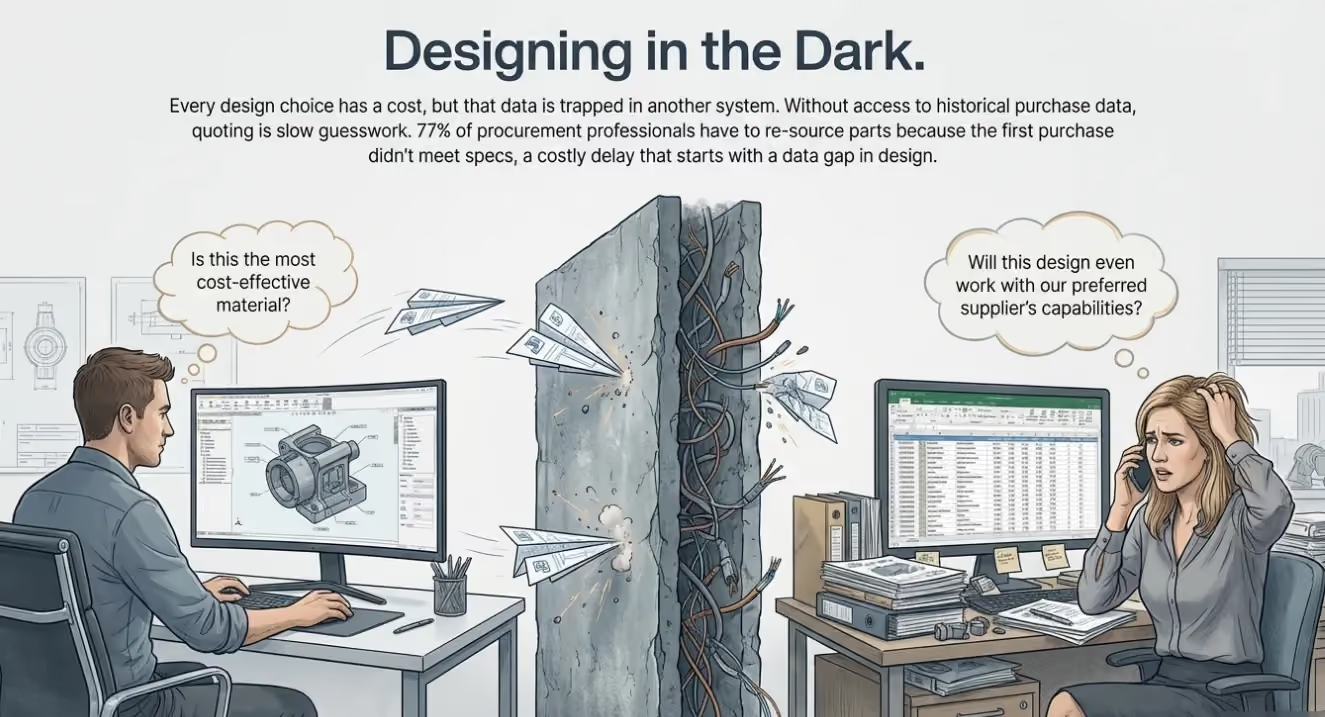
The Challenge: A key professional goal for Design Engineers is achieving true Design for Manufacturability (DFM) mastery, which earns the respect of the shop floor. However, there is often a cultural gap, leading to designs that are technically sound but difficult or excessively costly to produce. Design decisions determine about 80% of a product's cost. Yet, engineers typically lack immediate, transparent access to real-world procurement data to inform decisions about tolerances, materials, and processes early in the design phase.
Why It Matters Now: To maintain profit margins, engineers must actively engage in Value Engineering (VE) by focusing on design optimization. This cross-functional effort requires close collaboration with procurement and manufacturing to assess tradeoffs, like loosening tolerances or switching materials, without compromising quality.
How CADDi Helps: CADDi is designed to enhance DFM efforts by facilitating seamless integration across engineering, procurement, and manufacturing departments. The platform links price data, supplier information, and cost breakdowns directly to the drawing. Through similarity search, engineers can quickly compare their new design idea against similar past parts, instantly seeing which design elements (e.g., complexity, material) drove up costs or resulted in quality defects. This objective, data-driven insight empowers the engineer to make optimal material choices and refine designs before tooling begins.
5. Reclaiming Time from Administrative Friction
The Challenge: Due to constant context switching and time spent on administrative tasks—such as processing documentation and manually searching through files—Design Engineers only dedicate 20-30% of their time to core CAD work. Tasks like identifying and organizing relevant data for design, manufacturing, and purchasing consume valuable hours.
Why It Matters Now: Time spent on low-value, non-productive tasks like searching slows the entire product development process. Accelerating speed to market is a top priority for manufacturers. Every hour reclaimed from administrative drudgery can be reallocated to high-value work like innovation and complex component design.
How CADDi Helps: CADDi streamlines the engineering process by automating the laborious tasks of data collection and organization. Users have reported reducing drawing search time by significant amounts—for instance, achieving a reduction equivalent to one full-time worker per month at Ebara Corporation. By consolidating drawings, extracted information, and purchasing data into a single, accessible platform, CADDi ensures that the engineering team spends less time searching for data and more time designing.
The Future of Design is Data-Driven
For Industrial Machinery manufacturers, the path to agility and reduced costs runs directly through the engineering department. By transforming scattered intellectual property into an actionable asset, platforms like CADDi remove the systemic friction that bogs down the design process. This shift allows engineers to move beyond being functional buffers and truly focus on the innovation that will drive the next century of industrial manufacturing.
To learn more about optimizing design decisions and lowering costs, download our complementary resource. Or, see how CADDi can transform your own legacy drawing archives by requesting a personalized demo.
Design Engineers in the Industrial Machinery sector (NAICS 333) are the architects of physical reality, responsible for translating customer needs into complex, functional equipment. Yet, the modern reality of this role is less about pure creative design and more about administrative friction. Often serving as a "Functional Buffer" between theoretical R&D and the shop floor's physical constraints, designers spend a disproportionate amount of time navigating legacy Product Data Management (PDM) systems, manually reconciling fragmented data, and struggling with cross-functional conflict.
In today’s fast-paced environment—characterized by high-mix variability and intense pressure to increase speed to market—this administrative overhead is no longer sustainable. Core design work (CAD/FEA) is often reduced from an ideal 60% of an engineer's time to a mere 20-30% because hours are consumed by meetings, documentation (Engineering Change Orders or ECOs), and administrative PDM tasks.
By leveraging modern Manufacturing Intelligence solutions, design engineers can eliminate this friction, shifting their focus back to innovation and high-value strategic activities.
Here are five critical challenges facing Industrial Machinery Design Engineers and how CADDi, the AI data platform for manufacturing, helps solve them.
1. The Hidden Cost of Reinventing the Wheel
The Challenge: It is surprisingly common for engineers to spend time designing entirely new parts that are functionally identical or nearly identical to parts already manufactured or sourced in the past. This occurs because the time required to search for relevant prior designs in disorganized file systems or through limited traditional search methods makes it feel "faster to draw a new one than to search for a drawing". This duplication leads to rampant parts proliferation, ballooning procurement costs and inventory complexity.
Why It Matters Now: In a period where rising costs are the top concern for manufacturing leaders, reducing unnecessary component variations is a direct path to savings. Duplicative designs incur many unnecessary costs, including increased inventory management complexity and lost bulk purchasing opportunities.
How CADDi Helps: CADDi Drawer’s patented similarity search uses AI to analyze the geometric shape of a new design (even from a rough sketch or drawing) and instantly surfaces all similar parts previously engineered or purchased. This eliminates redundant work, enabling design reuse and standardization. Instead of starting from a blank screen, engineers start from a proven design, leading to a substantial reduction in design time and cutting engineering costs.
2. Bridging the Generational Knowledge Gap
The Challenge: Design Engineers function as a "Generational Buffer," bridging the expertise of retiring senior staff—who hold deep, "tribal knowledge" of machining and process constraints—with the digital requirements of newer teams. When veteran engineers retire, critical institutional knowledge about why a specific part was designed a certain way, or which suppliers failed to meet quality standards, is lost forever.
Why It Matters Now: The manufacturing sector faces a persistent talent shortage and a wave of veteran retirements. This knowledge drain slows new hire onboarding, often requiring new engineers to constantly interrupt senior staff for basic information, which taxes the entire department.
How CADDi Helps: CADDi functions as the organization’s "digital brain" or "digital mentor," democratizing institutional knowledge. By utilizing proprietary OCR-based AI technology, CADDi digitizes and extracts information from every drawing (including legacy 2D and handwritten notes) and links it with all historical procurement, quality, and supplier data. New hires can search intuitively using keywords or part shapes, bypassing the need to memorize arbitrary drawing numbers or interrupt senior staff, making them productive much faster.
3. Overcoming the PDM/PLM Search Bottleneck
The Challenge: While Product Data Management (PDM) systems are crucial "systems of record" for version control, their search capabilities are often limited. Legacy systems force engineers to rely on searching by specific file names or part IDs. This outdated methodology contributes to the infamous "check-in/check-out" wars and performance latency (the "spinning blue wheel") that halts assembly progress for minutes at a time.
Why It Matters Now: The inherent slowness and limitations of traditional search methods create data gaps. Engineers waste valuable time waiting for systems to respond or searching through irrelevant results. Efficient data retrieval is fundamental to keeping complex machinery development on schedule.
How CADDi Helps: CADDi Drawer acts as a powerful "System of Insight" that complements existing PLM/PDM systems. It aggregates data from systems like ERP, PLM, and CAD into a single data lake, ensuring that all information is searchable and connected. By moving beyond rigid file management, CADDi’s advanced search capabilities—including similarity search and keyword search based on drawing content—allows teams to retrieve design and related data in seconds, rather than minutes or hours, thus directly mitigating the PDM-related friction.
4. Integrating Design for Manufacturability (DFM) with Cost Data
The Challenge: A key professional goal for Design Engineers is achieving true Design for Manufacturability (DFM) mastery, which earns the respect of the shop floor. However, there is often a cultural gap, leading to designs that are technically sound but difficult or excessively costly to produce. Design decisions determine about 80% of a product's cost. Yet, engineers typically lack immediate, transparent access to real-world procurement data to inform decisions about tolerances, materials, and processes early in the design phase.
Why It Matters Now: To maintain profit margins, engineers must actively engage in Value Engineering (VE) by focusing on design optimization. This cross-functional effort requires close collaboration with procurement and manufacturing to assess tradeoffs, like loosening tolerances or switching materials, without compromising quality.
How CADDi Helps: CADDi is designed to enhance DFM efforts by facilitating seamless integration across engineering, procurement, and manufacturing departments. The platform links price data, supplier information, and cost breakdowns directly to the drawing. Through similarity search, engineers can quickly compare their new design idea against similar past parts, instantly seeing which design elements (e.g., complexity, material) drove up costs or resulted in quality defects. This objective, data-driven insight empowers the engineer to make optimal material choices and refine designs before tooling begins.
5. Reclaiming Time from Administrative Friction
The Challenge: Due to constant context switching and time spent on administrative tasks—such as processing documentation and manually searching through files—Design Engineers only dedicate 20-30% of their time to core CAD work. Tasks like identifying and organizing relevant data for design, manufacturing, and purchasing consume valuable hours.
Why It Matters Now: Time spent on low-value, non-productive tasks like searching slows the entire product development process. Accelerating speed to market is a top priority for manufacturers. Every hour reclaimed from administrative drudgery can be reallocated to high-value work like innovation and complex component design.
How CADDi Helps: CADDi streamlines the engineering process by automating the laborious tasks of data collection and organization. Users have reported reducing drawing search time by significant amounts—for instance, achieving a reduction equivalent to one full-time worker per month at Ebara Corporation. By consolidating drawings, extracted information, and purchasing data into a single, accessible platform, CADDi ensures that the engineering team spends less time searching for data and more time designing.
The Future of Design is Data-Driven
For Industrial Machinery manufacturers, the path to agility and reduced costs runs directly through the engineering department. By transforming scattered intellectual property into an actionable asset, platforms like CADDi remove the systemic friction that bogs down the design process. This shift allows engineers to move beyond being functional buffers and truly focus on the innovation that will drive the next century of industrial manufacturing.
To learn more about optimizing design decisions and lowering costs, download our complementary resource. Or, see how CADDi can transform your own legacy drawing archives by requesting a personalized demo.
Ready to see CADDi Drawer in action? Get a personalized demo.
Subscribe to our Blog!
.svg)
.svg)
.svg)

Related Resources