.svg)


.png)




%201.svg)
After merging four companies in 2021, Astemo found itself managing duplicate workflows and disconnected systems, forcing teams to keep running each legacy company's processes side by side rather than as one. Rushing to integrate meant piecing together a "lowest common multiple" system that tried to satisfy every legacy company's needs at once, and the resulting time lost hunting for product data hit overseas sites especially hard.
%202.svg)
With less time spent gathering and verifying quoting and production data, Astemo's team redirected their energy toward higher-value work like competitive research and refining customer requirements, while also picking up momentum on quality inspection reviews and shorter production launch timelines. Adopting CADDi became the catalyst for a broader culture of self-driven digital adoption among frontline staff.
Vietnam's motorcycle market is now entering maturity. With the population surpassing 100 million and the country rapidly growing wealthier, a motorcycle market that once grew steadily year over year is nearing saturation, and the next wave, a shift to EVs, is already beginning to arrive.
For Astemo, which makes motorcycle suspension systems, this shift raised a question that goes to the core of the business: how to hold onto market share and keep winning against competitors within a shrinking pie. Answering that question meant freeing up the team's time and energy to focus on higher-value, strategic work, like tracking competitor activity and improving how the company responds to customer requirements.
But in practice, the team was buried under manual work and duplicated effort. Everyone knew that taking action to stay competitive was urgent, but there simply wasn't time to do it. Structural busyness kept holding back any real change.
Growth Through a Four-Company Merger, and a "Chain of Duplication and Manual Work"
Astemo Corporation covers a wide range of products spanning both four-wheel and two-wheel vehicles, including electric powertrains and advanced chassis systems. Formed through the merger of four companies in January 2021, the company launched with high hopes of expanding sales channels and improving R&D efficiency by combining each company's strengths.
But the road to integration brought harsh realities. The first obstacle was fragmentation across the legacy organizations, and Astemo was no exception. Each of the four legacy companies had kept its own separate systems, everything from design and development tools to ERP, leaving information fragmented. And the problem wasn't limited to systems. Even something as fundamental as the process from customer inquiry to the start of mass production differed completely across the four legacy companies.
General Director Shintaro Hikuma described the toll this took directly, explaining that his team had to keep producing documents the old way while simultaneously complying with the rules of the new Astemo, effectively doubling their workload.
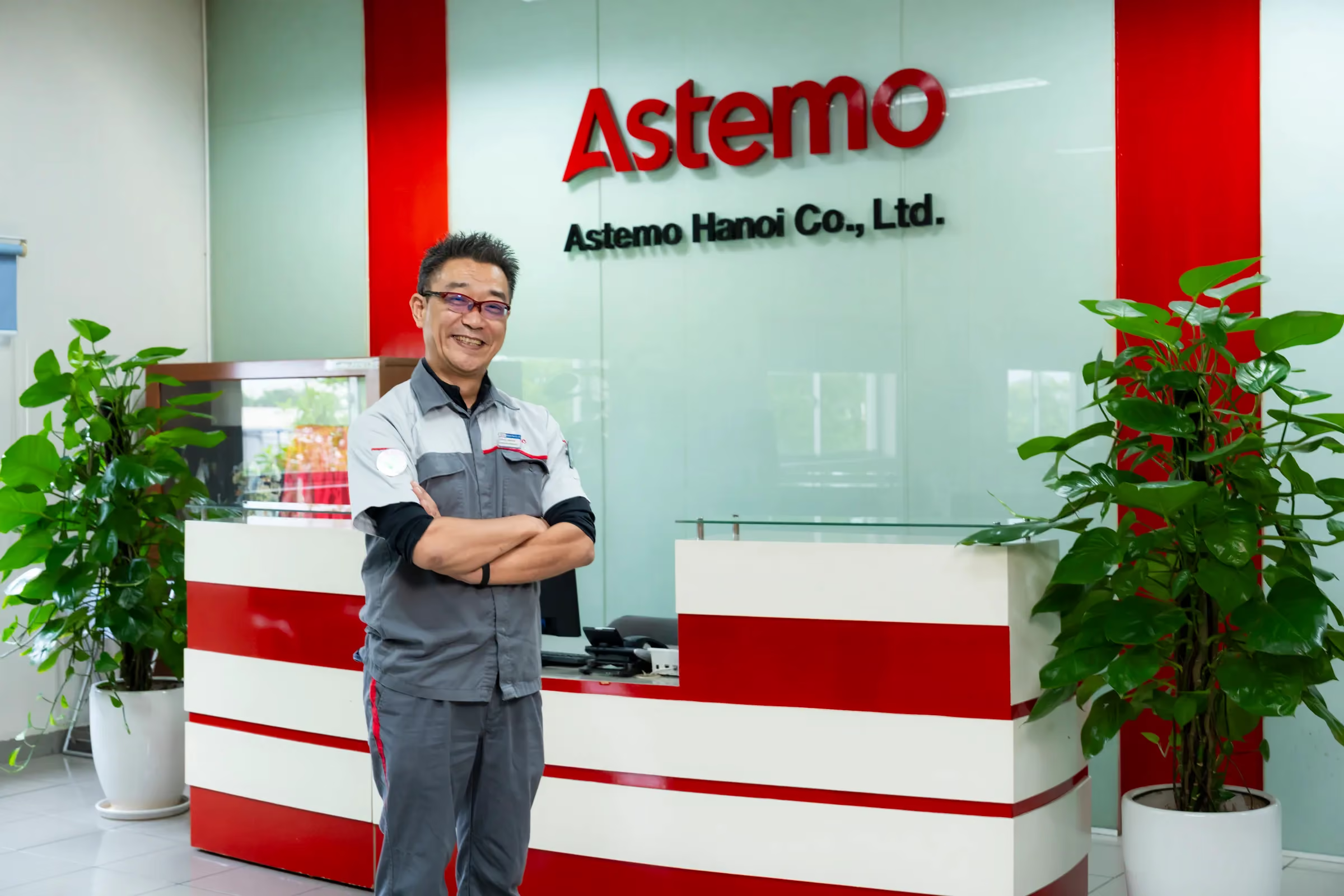
In the integration project, prioritizing speed led to building a large, unwieldy system and set of business processes that tried to accommodate every legacy company's way of doing things. Looking back, Shintaro describes it as having "created rules based on a lowest-common-multiple mindset," reflecting that the team hadn't been able to sufficiently simplify requirements at the time.
Around that time, at Astemo, physical distance compounded the problem, making it chronically difficult to access information like design and cost data. The time spent tracking down that information kept eating into the team's actual work.
A Shift in Frontline Reception Brings an Organizational Gear Change
The catalyst for change came from a chance encounter: the division leader at the time crossed paths with CADDi Inc. at a trade show and, intrigued by what he saw, encouraged Shintaro to look into the company further. Shintaro researched CADDi right before his posting to Vietnam and immediately sensed it was a very strong match for the problems they were facing.
Getting it to take hold on the ground wasn't easy, though. At first, few team members initially saw it as something directly relevant to their own work.
What changed things was hands-on experience with a CADDi demo. Showing skeptical team members the actual Similarity Search and Document Linking features sparked a lightbulb moment, and they quickly began to grasp the practical value it could bring to their work.
{{quote-1}}
That hands-on sense of "this actually works," felt directly by the people on the ground, is what changed the mood across the organization.
And the deciding factor in adopting CADDi wasn't just that the tool proved useful in practice. Shintaro adds that it also came down to CADDi's deep understanding of manufacturing, and the trust that built.
General Director Shintaro Hikuma noted that CADDi's team came to their factory to understand what was happening on the ground, and that the simple and transparent nature of their proposals made CADDi different from other vendors. More than anything, he felt on an instinctive level that he wanted to work with people who approached problem-solving with real passion and a mission to transform Japanese manufacturing.
Shifting Toward Higher-Value Work, and a Natural Turn Toward an IT Culture
Rollout began with three departments: production engineering, the project management team, and quality assurance. Since quoting and form management were where the pain points were felt most strongly, adoption spread quickly.
From there, real change started to take hold. With much less time spent gathering and verifying information, the team could start considering how to redirect resources into new areas.
Quality inspection illustrates this well. Historically, each new problem prompted the addition of another inspection item, but the team never had time to revisit whether earlier inspections were still necessary, causing the workload to grow steadily over time. Now, with that time reclaimed, the team can question whether each inspection still serves a purpose, and expects this practice to reduce the overall inspection burden. There is also growing optimism that AI could help ease the load of approval processes and similar tasks going forward.
Another major outcome mentioned was that a team once entirely consumed by responding to customer requests can now proactively research competitor activity and think ahead about creating value before being asked. Given the company's original goal of maintaining market share, that shift matters a great deal.
An unexpected change also emerged. General Director Shintaro Hikuma observed that team members have grown noticeably more proactive about using digital tools, increasingly approaching problems with a sense that they can tackle solutions themselves. He credits this shift directly to their hands-on experience with CADDi.
Team members who were once skeptical of IT and digital tools now come forward on their own with questions and requests about the tool. A culture of embracing digital technology is starting to take root within the organization.
"Start Small, Grow Big": The First Step Forward
The team is working to optimize quoting processes overall and shorten production launch lead times using CADDi Drawer. This momentum is helping build a structure that can respond to customer needs more quickly and flexibly.
Shintaro's next focus is creating synergy across company divisions. While respecting each site's own priorities, the plan is to eliminate wasteful duplication across group companies that strains cash flow, generating two or even three times the synergy.
Beyond that lies an even bigger vision: visualizing and optimizing the global supply chain, and unifying inventory management systems across the group.
General Director Shintaro Hikuma believes that value comes from having a countermeasure for every failure encountered along the way. He hopes leaders will give frontline teams real opportunities to try new things, and that the people driving change on the ground will have the resolve and boldness to keep pushing forward by starting small. As he put it, holding back on change means the thousands of people on the ground end up paying the price for years to come, while if something fails, he alone bears the responsibility as the person who championed it. That calculation is what led him to simply try.
Rather than waiting for perfect preparation, start at the smallest possible scale and let hands-on experience change the organization. Building a culture, together, from both leadership and the frontline, where people aren't afraid to fail and keep trying. That's the essential lesson Astemo's digital transformation push has proven.
One site's success now serves as the starting point for productivity gains across the entire Astemo group, and its momentum toward stronger competitiveness continues to build.
Ready to see CADDi Drawer in action?
Get a personalized demo.


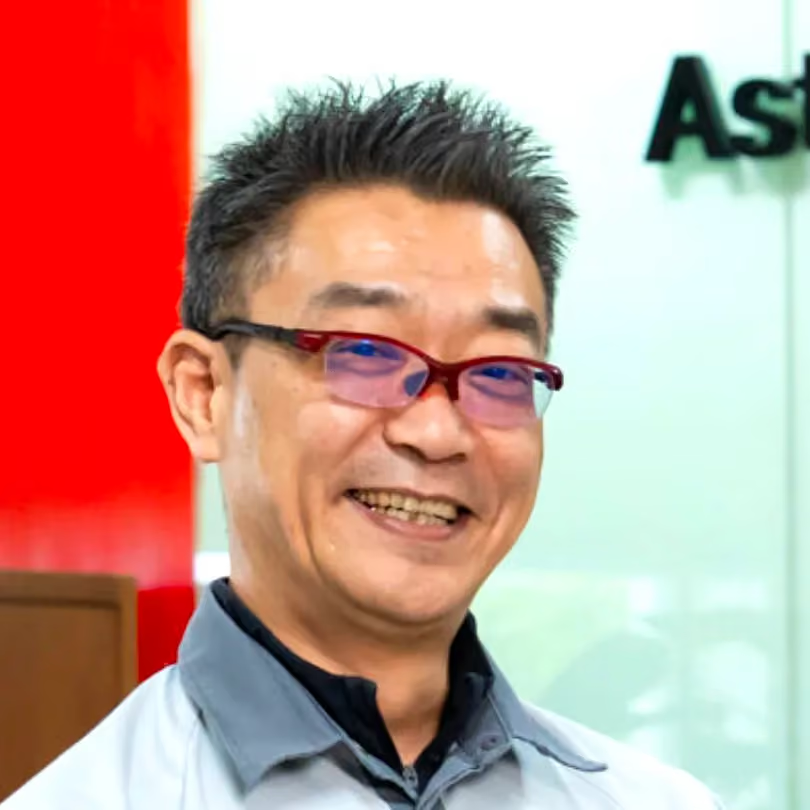
"Once frontline staff experienced CADDi firsthand and realized, 'this really will save us time,' I could feel the mindset of previously skeptical managers shift in a positive direction too."




.png)

