.svg)


.png)



%201.svg)
With limited resources, the team had little time to spare for value-added proposals to customers or for developing core technology further. Their efforts were confined to surface-level efficiency gains and partial automation using in-house tools, leaving little room to address deeper structural issues.
%202.svg)
By tackling the design rework challenge head-on, the newly available capacity once spent on repetitive fixes was redirected toward higher-value work. Lead times shortened as a result.
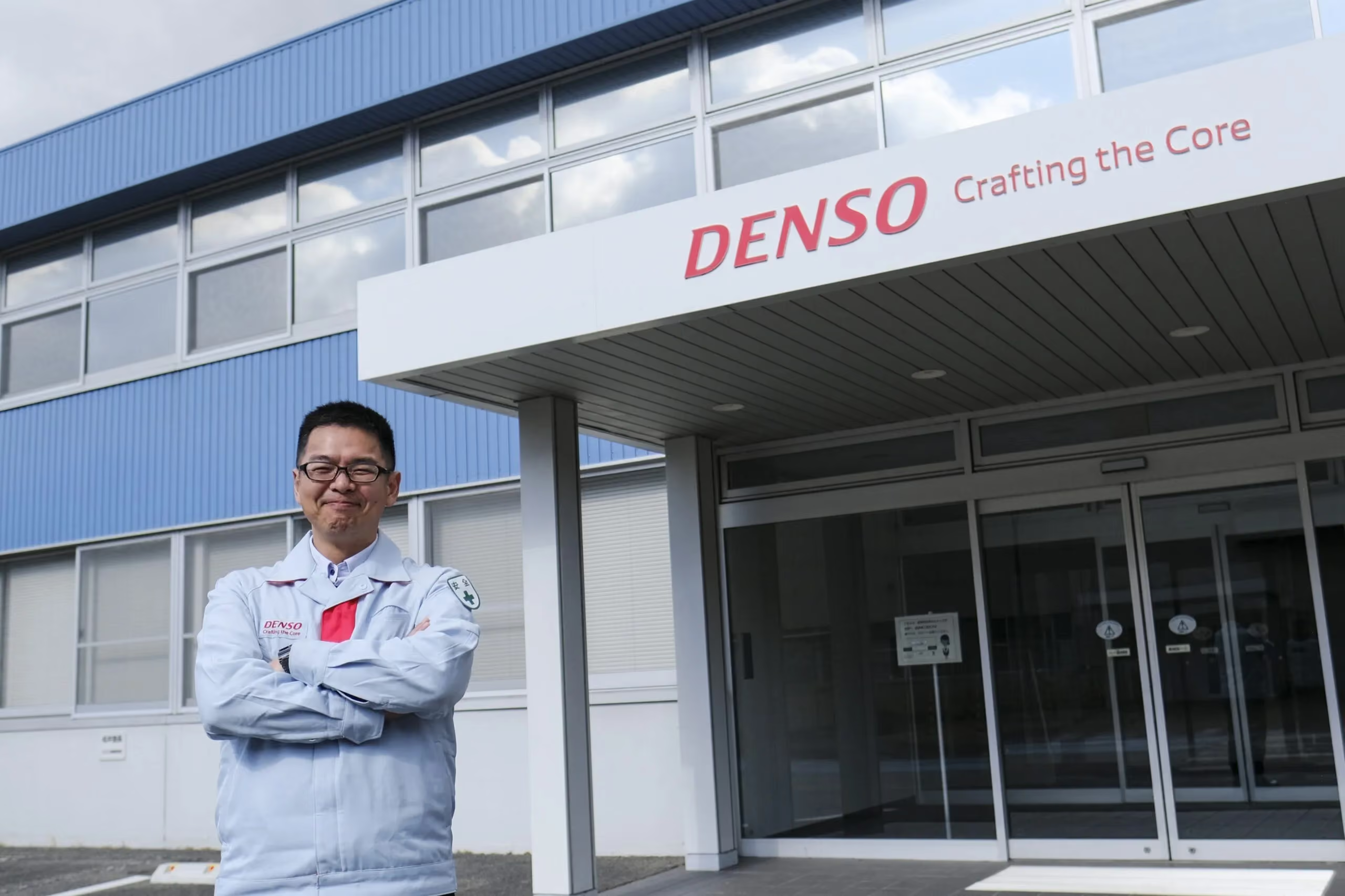
Since joining DENSO in 2005, Takahiro Oba has spent nearly 20 years on process design for engine cooling products and thermal equipment within DENSO's Thermal Systems business group. As manager of the Future Factory Strategy Office within the Air Conditioning Equipment Manufacturing Department, he had grown increasingly concerned about two challenges facing the company: shortening lead time and freeing up capacity.
The first challenge, shortening lead time, stemmed from an unrelenting pace of change in the global market. Competition, especially from rising Chinese manufacturers, meant the old timelines no longer worked. What the market demanded was high-quality products delivered on a shorter lead time. To cut development lead time in half and reinvest the freed-up capacity into future value creation, DENSO needed to fundamentally rethink how it worked.
But teams on the ground were consumed by day-to-day work, with little time for the core technology development and customer proposals they should have been focused on. Freeing up capacity became the second urgent priority.
The push for change came from the division head, who suggested bringing in an outside partner. An internal referral led them to CADDi. Oba's first impression was that CADDi was just another AI startup. That impression changed once the conversations began.
{{quote-1}}
Among the vendors DENSO spoke with, CADDi was the only one that grasped the challenges on the ground and understood the specific context of manufacturing. That understanding tipped the decision toward a pilot of CADDi, the manufacturing AI data platform.
Confronting a long-avoided problem
The depth of the conversations with CADDi was one of the key factors behind DENSO's decision to move to full adoption. Those conversations surfaced an uncomfortable truth behind the capacity problem: engineers didn't document why they made a change, so the next person couldn't build on that decision and ended up redoing the work. Without documentation, that knowledge couldn't be referenced during later design work.
Confronting the issue of rework was a challenge. Employees were aware rework existed, but it had come to be seen as something that just happens rather than a problem to solve. Through the conversations with CADDi, that changed: stakeholders, including senior leadership, became motivated to solve it.
{{quote-2}}
Without those conversations, Oba believes DENSO might have taken the long way around, chasing surface-level fixes instead of the root cause. Once the team defined the core issue as reducing rework, the division head took ownership of the initiative himself, called for it to be division-led, and built a one-team structure together with frontline leaders.
Delivering results that exceeded expectations
DENSO is now running several pilots using CADDi. Results are showing in one of the harder areas to tackle: automating process FMEA (Failure Mode and Effects Analysis), which requires capturing human thought processes in structured form. The accuracy has exceeded the team's expectations, energizing them to try automating other processes as well.
CADDi Drawer, CADDi's cloud application for manufacturing data utilization, played a key role in extracting and applying knowledge from documents the company had accumulated over the years. Early on, with other vendor solutions also on the table, the team debated whether it was worth consolidating data specifically on CADDi. The results mattered for reasons that went beyond choosing one tool over another.
{{quote-3}}
CADDi also became the foundation for converting tacit knowledge, drawings, and technical materials that had long been siloed with individual experts, into explicit knowledge accessible to everyone. That path wasn't smooth. The team ran into real challenges with how past data had been kept: missing information and gaps in context surfaced as they tried to turn existing knowledge into structured data.
Oba came away with a clear realization: the reasoning behind past outcomes had never been preserved, and recognizing that gap became valuable for deciding what to do next.
Now that the issue is defined, attitudes on the ground are shifting. Oba is working to encourage members of the working group to speak up and to flag when more data is needed.
Together, these efforts let DENSO automate FMEA, structuring tacit knowledge into explicit, high-precision assets. By building an environment where designers can draw on past knowledge, a pattern is emerging: preventing rework before it happens while also shortening lead time.
Combining in-house ownership with outside expertise
DENSO has long had a culture of self-reliance, built on the belief that there's nothing the company can't do itself. This time, it deliberately chose to bring in outside help.
Oba points to a limit on how fast purely internal development can move. Bringing in outside expertise accelerated the pilots, and CADDi's customer success team gave DENSO a consistent source of outside perspective, including objective feedback on how DENSO compares to other companies.
The project drew a clear line: harder automation work and advanced problem-solving would be tackled together with CADDi, while smaller frontline improvements and tool-building would stay in-house, through what the team calls citizen development. Oba notes that tools go unused if the team doesn't build them itself, so alongside the CADDi partnership, DENSO is also nurturing the culture of self-driven improvement that has always been part of its DNA.
By 2030, freeing up the capacity of 1,000 people globally
With the pilot underway, the goal ahead is concrete. DENSO wants to confirm the impact of the current pilot within the next fiscal year and treat the end of fiscal year 2027 as a milestone for delivering results.
{{quote-4}}
Beyond that, DENSO plans to take the model built in Japan and roll it out to overseas sites, starting with China, for a multiplying effect at global scale.
Twenty years into his career, Oba has moved beyond the boundaries of production engineering to pursue transformation with an eye on total optimization. He used to work entirely within the boundaries of production engineering; now he thinks about the bigger picture. A straightforward KPI like cycle time used to be enough, but figuring out how to set KPIs for something as hard to measure as digitalization through AI is a new kind of challenge.
Since joining DENSO, Oba has been told not to be afraid to fail and to take on challenges, and given the freedom to pursue more technology. Using the capacity freed up by CADDi, he wants to make higher-value proposals, reduce defects, and raise the quality of DENSO's manufacturing, working with DENSO's promotion team and CADDi to build that future.
Oba also values the outside perspective CADDi's customer success team continues to provide on industry trends, calling that information and those insights valuable assets to DENSO.
DENSO and CADDi's collaboration is working to establish a new standard for value creation: freeing up capacity and shortening lead time through AI, and the manufacturing DX that lies beyond it.
Ready to see CADDi Drawer in action?
Get a personalized demo.


"The fact that CADDi started out in manufacturing itself was a major advantage for us. We didn't have to explain manufacturing context from scratch, and that made the conversations go incredibly smoothly."
"Through our conversations with CADDi, stakeholders, including senior leadership, became genuinely motivated to solve design rework, and that turned into a really productive space."
"Organizing our knowledge within a single tool gave us a real insight toward true transformation, the idea that we could actually change how we work and our processes themselves. That was a major takeaway."
"By 2030, including global rollout, we want to achieve efficiency gains equivalent to freeing up the capacity of about 1,000 people."




.png)

