
Mitsubishi Materials USA

Unlocking the Potential of High-Value Custom Engineering

Case Study

Unlocking the Potential of High-Value Custom Engineering

Mitsubishi Materials USA

Established
1984
Number of Employees
Sales
Business Activities
Cutting tools, carbide products, electronic materials and components

Facebook Logo - Caddi Drawer - Drawing Search SoftwareTwitter Logo - Caddi Drawer - Drawing Search SoftwareLinkedIn Logo - Caddi Drawer - Drawing Search SoftwareEmail Icon - Caddi Drawer - Drawing Search Software

Before

Mitsubishi Materials already incorporated modern data management practices, but needed to take it to the next level in order to make custom-engineered products more efficient.

After

With CADDi, new custom projects get off the ground faster, with quick and accurate lookup of relevant previous drawings to work from.

Mitsubishi Materials USA (MMUS) operates in a dynamic sector, specializing in the manufacturing of standard and custom-engineered cutting tools for the machining industry. Although they already incorporated modern data management practices, they sought cutting-edge tools to make the custom-engineered side of business even more efficient. We’re excited to announce that CADDi was chosen to help take their engineering and sales processes to the next level.
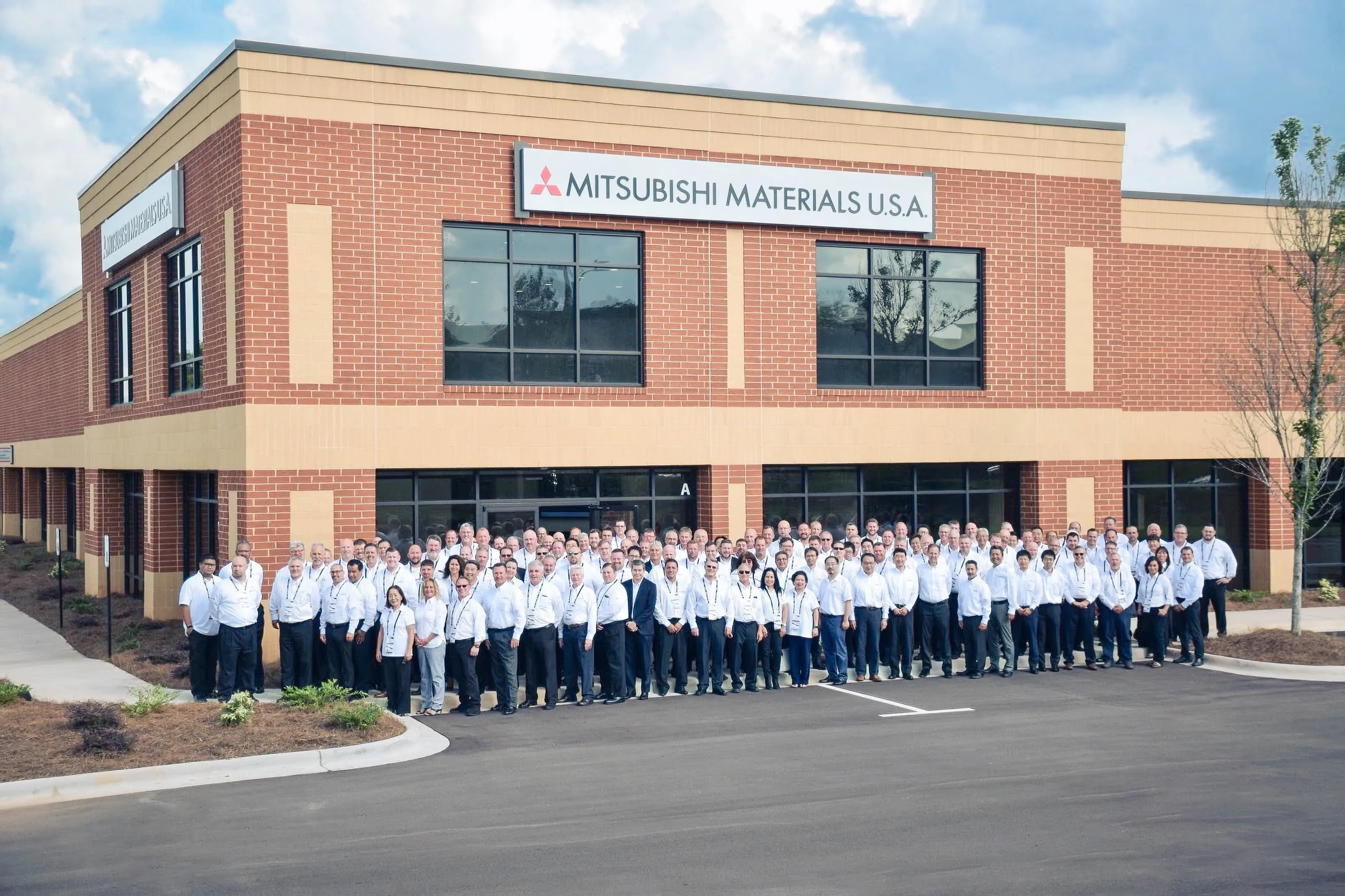
Photo courtesy of Mitsubishi Materials USA.

Centralizing Knowledge to Accelerate Design Insights

Mitsubishi Materials USA implemented CADDi to take their repository of engineering and sales data and make it more searchable and insightful. When tackling a new engineering project, CADDi can instantly surface relevant past designs to give design engineers a head start. Everything from past design revisions to quality reports is collected for each drawing, allowing engineers to accelerate their design process and more efficiently incorporate the lessons learned from past projects.

Accelerating Quoting with Dynamic Data Searching

When new custom orders come in, CADDi’s dynamic search capabilities help streamline workflows. CADDi’s ability to search and index information extracted from drawings, materials, and notes allows the sales teams to find relevant data from any starting point. They can quickly verify if a requested custom design is similar to a previously manufactured project and extract relevant information without a back-and-forth with the engineering department or the requesting company to get specific information.

A regional sales manager for Mitsubishi Materials USA spoke on the ability to find critical sales and cost data quickly:

“How cool to just go in and search a quote number, tool number, or customer and get exactly what I need — without trying to maintain that on my own.”

- A regional sales manager, Mitsubishi Materials USA

Mitsubishi is looking forward to expanding CADDi’s application beyond the initial implementation. As more team members get up to speed on using CADDi and integrate it into their workflows, it creates productivity gains larger than the sum of their parts. By continuously utilizing CADDi, Mitsubishi Materials USA is ensuring that its custom engineering is supported by fast, consistent, and searchable knowledge.

Ready to see CADDi Drawer in action? Get a personalized demo.

Book a Demo
This is some text inside of a div block.

Take this case study on-the-go

Download PDF Now

Unlocking the Potential of High-Value Custom Engineering

Unlocking the Potential of High-Value Custom Engineering

Before

Mitsubishi Materials already incorporated modern data management practices, but needed to take it to the next level in order to make custom-engineered products more efficient.

After

With CADDi, new custom projects get off the ground faster, with quick and accurate lookup of relevant previous drawings to work from.

Mitsubishi Materials USA (MMUS) operates in a dynamic sector, specializing in the manufacturing of standard and custom-engineered cutting tools for the machining industry. Although they already incorporated modern data management practices, they sought cutting-edge tools to make the custom-engineered side of business even more efficient. We’re excited to announce that CADDi was chosen to help take their engineering and sales processes to the next level.

Photo courtesy of Mitsubishi Materials USA.

Centralizing Knowledge to Accelerate Design Insights

Mitsubishi Materials USA implemented CADDi to take their repository of engineering and sales data and make it more searchable and insightful. When tackling a new engineering project, CADDi can instantly surface relevant past designs to give design engineers a head start. Everything from past design revisions to quality reports is collected for each drawing, allowing engineers to accelerate their design process and more efficiently incorporate the lessons learned from past projects.

Accelerating Quoting with Dynamic Data Searching

When new custom orders come in, CADDi’s dynamic search capabilities help streamline workflows. CADDi’s ability to search and index information extracted from drawings, materials, and notes allows the sales teams to find relevant data from any starting point. They can quickly verify if a requested custom design is similar to a previously manufactured project and extract relevant information without a back-and-forth with the engineering department or the requesting company to get specific information.

A regional sales manager for Mitsubishi Materials USA spoke on the ability to find critical sales and cost data quickly:

“How cool to just go in and search a quote number, tool number, or customer and get exactly what I need — without trying to maintain that on my own.”

- A regional sales manager, Mitsubishi Materials USA

Mitsubishi is looking forward to expanding CADDi’s application beyond the initial implementation. As more team members get up to speed on using CADDi and integrate it into their workflows, it creates productivity gains larger than the sum of their parts. By continuously utilizing CADDi, Mitsubishi Materials USA is ensuring that its custom engineering is supported by fast, consistent, and searchable knowledge.

Ready to see CADDi Drawer in action?
Get a personalized demo.

Book a Demo

Heading 1

Modern stumbling blocks for procurement

Heading 3

Heading 4

Heading 5
Heading 6

Since its founding in 1954, DCC Automation / Dairy Conveyor Corp. has become a trusted name in hygienic and performance-driven automation. The company designs and manufactures high-quality conveyor systems, robotic palletizers, custom control panels, and end-of-line packaging solutions. DCC’s Evolution Line featuring the Auto-Pack Caser, Round Bottle Caser, and Slant Caser demonstrates its commitment to precision, cleanliness, and flexibility. Each system is engineered to meet the diverse needs of today’s dairy, food, beverage, and household industries. With recent recognition such as the 2024 Rockwell Automation PartnerNetwork™ OEM Innovation Award, DCC Automation continues to redefine performance standards and drive progress across the global manufacturing landscape.


Their key projects, including palletizers and casers, often involved up to 800 separate line items, resulting in a lengthy procurement process. External factors further complicated this process, making efficiency a challenge. In the modern era of supply chain disruption and complexity, DCC recognized the need to re-evaluate their procurement costs. Factors such as geopolitical relations, ongoing and upcoming tariffs, and material shortages can make previously viable purchasing strategies less sustainable, prompting a strategic re-evaluation.


Unfortunately, making these new procurement strategic decisions requires a lot of experience and expertise. DCC found that the required knowledge was inadequately distributed among different teams, ending up in silos and known only by specific individuals. Existing data management structures, like ERP tools or Solidworks, made the data technically available, but not easily accessible. Different teams working in different systems had a hard time sharing insights and information.


On top of this, a specific initiative in one of DCC’s branches was to consolidate suppliers based on expertise. This is a complicated procurement initiative that requires a lot of manual cross-referencing and expertise – knowing where to find categories of component parts that are similar enough, and finding the ideal quality-price tradeoff point for each category. Processes such as these, that require specific experts to track down data, slow the entire company’s progress towards their goals by taking these people away from other valuable work. The most valuable procurement experts were being stretched too thin.

Block quote

Ordered list

  1. Item 1
  2. Item 2
  3. Item 3

Unordered list

  • Item A
  • Item B
  • Item C

Text link

Bold text

Emphasis

Superscript

Subscript

This is some text inside of a div block.

Don’t Miss Out!

Discover the secrets behind our customers’ success. Download our exclusive case study pdf before you go.
Button Text

Schedule a sales call

Fill out form: Step 1 of 2
Oops! Something went wrong while submitting the form.
Thank you! Your submission has been received.