.svg)

Tariffs and the Offroad Component Maker: A US Manufacturer's Playbook

Table of Contents

For most of the last two decades, building an offroad rig was a global exercise. A US-designed lift kit might use Korean cold-rolled steel, Mexican CNC machining, Taiwanese fasteners, and a Chinese-sourced electronic control module. The bill of materials (BOM) for a single suspension assembly could touch six countries before it ever bolted onto a Jeep, a Bronco, a side-by-side, or a desert prerunner.
That model is breaking. Tariffs — and the broader trade-policy volatility behind them — have fundamentally altered the cost structure of industrial component production in the United States. More than three-quarters of US manufacturers now cite trade uncertainty as their top concern, and tariffs are projected to raise $2.1 trillion in federal revenue over the next decade. For offroad component manufacturers, who already operate in a high-mix, low-volume world with thin margins and demanding customers, the impact is acute.
This article looks at how tariffs are reshaping the offroad components sector specifically, where the real pressure points are landing inside US shops, and how a manufacturing data platform like CADDi gives engineers and procurement teams a faster way through the disruption.
What “tariffs” actually mean on a shop floor
At a macro level, tariffs are a tax on imported goods designed to make domestic production more competitive. At a shop-floor level, they are something much messier: a moving line item that triggers a cascade of re-engineering, re-sourcing, and re-quoting work.
When tariffs on imported steel, aluminum, hydraulic components, or electronics spike, the cost basis of a BOM balloons overnight. That cost has to go somewhere. According to recent industry research, 32% of manufacturers plan to pass tariff costs directly onto customers, but a much larger 54% are absorbing some of those costs through reduced margins or, more commonly, what executives call “efficiency gains.” That euphemism puts the burden squarely on engineering and procurement teams to find process improvements and alternative sourcing fast enough to offset the rising cost of raw materials.
In other words: a tariff doesn’t just change a price. It changes the job. Engineers stop optimizing surface finish on a machining strategy and start testing whether a domestic steel grade with slightly different metallurgical properties can withstand the same stress loads as the imported alloy they’ve used for ten years. Buyers stop chasing the lowest landed cost and start optimizing for what analysts now call “trade-insulated cost” — the true cost of a part once tariffs, tax credits, and FEOC (Foreign Entity of Concern) compliance rules are factored in.
Why offroad components are uniquely exposed
The offroad components sector — 4x4 aftermarket, powersports OEM and aftermarket, UTV and side-by-side parts, light truck accessories, overlanding gear, and the broader light off-highway segment — sits at an unusually exposed intersection of tariff-affected categories.
Heavy reliance on steel and aluminum. Skid plates, bumpers, rock sliders, control arms, axle housings, roll cages, and tube chassis are overwhelmingly fabricated from steel plate, tube, and bar stock or from aluminum extrusions and castings. Both categories sit at the center of Section 232 tariff schedules. When mill prices move, every welded and fabricated SKU in the catalog moves with them.
Castings and forgings as a chronic pain point. OEM and aftermarket executives across heavy and offroad machinery routinely cite castings and forgings as the single most acute supply chain pain point. Differential housings, knuckles, hubs, brake calipers, and transmission cases are difficult to dual-source domestically, and the foundry base in the US has thinned considerably over thirty years. Tariffs on imported castings amplify a constraint that already existed.
Electronics and sensors creeping into every product. Modern offroad components are increasingly “smart.” Locking differentials, electronic sway-bar disconnects, on-board air systems, winches, lighting, and adaptive suspension all carry control modules, sensors, and connectors that have historically come from Asia. Tariffs on electronic components hit precisely the sub-assemblies that were supposed to justify a premium price point.
Tier 2 and Tier 3 opacity. Most offroad component makers are mid-market shops. They know their direct suppliers well, but they often have limited visibility into the Tier 2 and Tier 3 origin of raw materials. That opacity becomes a real problem when domestic content thresholds and FEOC compliance start affecting tax credit eligibility for downstream OEM customers.
High-mix, low-volume production economics. Unlike a Tier 1 automotive supplier shipping a million identical brake rotors, an offroad component maker might produce 80 different SKUs across a season, with frequent design revisions and customer-specific variants. Every re-sourcing decision triggered by a tariff has to be evaluated against dozens of designs at once. The administrative overhead of “value engineering under duress” scales nonlinearly with SKU count.
The result is a sector under simultaneous cost pressure from raw materials, sub-assemblies, electronics, and compliance — with smaller teams and tighter margins than the Tier 1 automotive players who dominate the broader trade-policy conversation.
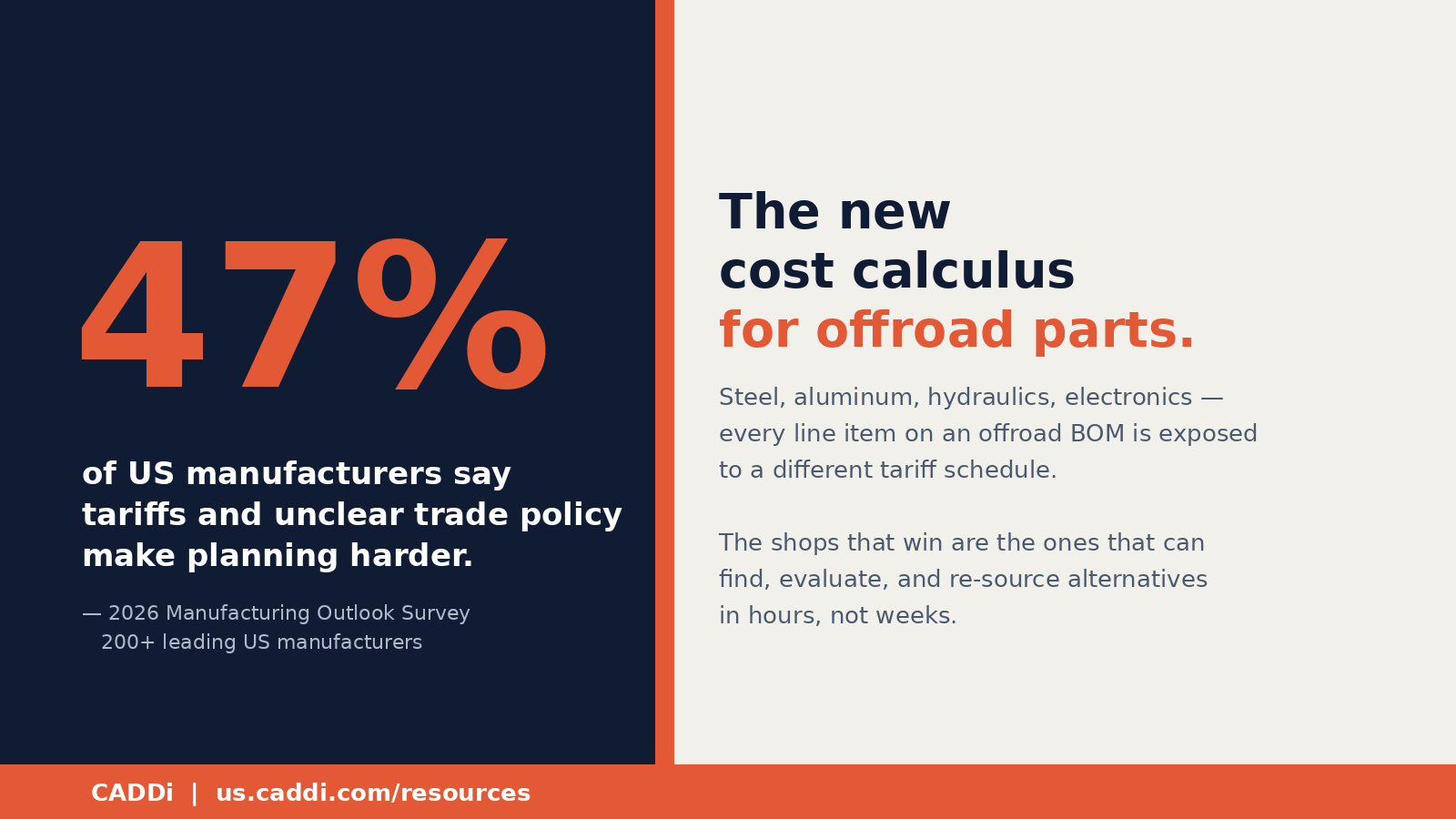
47% of US manufacturers say tariffs and unclear trade policies make planning harder. — 2026 Manufacturing Outlook Survey, CADDi (n = 200+ US manufacturers). Read the full report →
The three pressure points showing up in offroad shops right now
Across conversations with US offroad and light off-highway component manufacturers, three pressure points dominate the day-to-day:
1. “Value engineering emergencies.” A tariff lands on Monday, a 9% material cost increase shows up in Tuesday’s BOM run, and by Wednesday the engineering team is being asked to identify three alternative materials, two alternative geometries, and a list of domestic-capable suppliers — for parts that were perfectly fine the week before. This is non-value-added work that displaces actual product development.
2. The reshoring administrative burden. 68% of manufacturing leaders have prioritized onshoring as a key supply chain strategy. But reshoring is not a label change. Transferring a stamping or forging line from a low-cost overseas supplier to a domestic shop means re-validating tolerances, re-certifying weld procedures, re-qualifying coatings, and rebuilding the inspection plan. The engineering documentation alone can take months.
3. Tribal knowledge bottlenecks. When a buyer needs to know whether a similar part was ever sourced domestically — say, a comparable yoke that ran through a Pennsylvania forging shop in 2019 — that knowledge typically lives in one veteran’s head, or in a folder structure on a shared drive that only one person knows how to navigate. With 79% of manufacturers citing the skilled labor shortage as their biggest challenge, that veteran is often retiring or has already left.
These three pressures share a common root: the inability to find, compare, and act on historical engineering and procurement data fast enough to keep pace with policy changes. That is exactly the problem CADDi was built to solve.
How CADDi helps offroad component makers absorb tariff pressure
CADDi Drawer is an AI data platform for manufacturing that turns unstructured data — 2D drawings, purchase orders, supplier records, quality reports, change orders — into searchable, actionable intelligence linked to the actual part geometry rather than arbitrary IDs. For offroad component manufacturers facing tariff pressure, that translates into three concrete capabilities.
1. Find domestic alternatives in seconds, not weeks
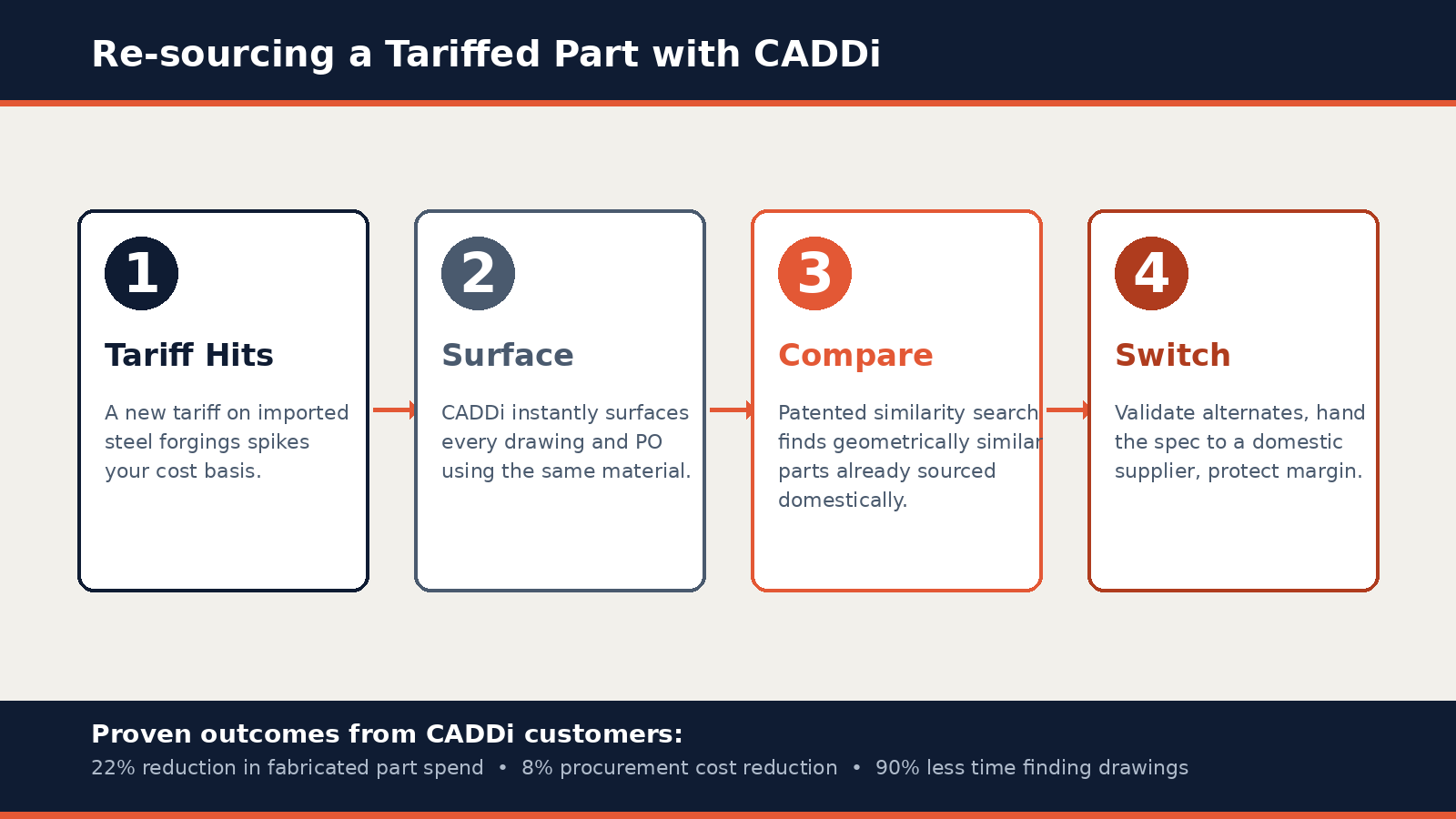
CADDi’s patented similarity search lets a buyer or engineer pull up any drawing — a control arm, a winch mount, a transfer case bracket — and instantly surface every geometrically similar part in the company’s history, along with every supplier, every PO, every price, and every quality outcome tied to those parts. When a tariff makes a foreign-sourced casting unviable, the team can see in seconds whether a similar part was ever made by a domestic shop, and what it cost.
Ebara Corporation, a $5B pump manufacturer, used CADDi to achieve an 8% procurement cost reduction and 1.4x faster supplier selection by linking drawing and purchasing data this way. Dairy Conveyor Corporation, a $50M industrial conveyor maker, achieved a 22% reduction in fabricated part spend by consolidating suppliers using the same approach — and one of their procurement professionals reported an 80% reduction in workflow time, turning week-long sourcing tasks into afternoon work.
2. Run Value Analysis / Value Engineering (VA/VE) at speed
VA/VE — the practice of finding cost-effective alternatives that still meet performance requirements — is the single most powerful lever a manufacturer has against tariff-driven cost increases. The problem is that traditional VA/VE is painfully slow. Engineers spend days hunting through file servers and emailing veterans to assemble the data they need before they can even start the analysis.
CADDi compresses that timeline dramatically. Izumi Techno reported a 90% reduction in drawing search time, with searches that used to take 5–10 minutes now taking 1–2. Punch Industry saw the same 90% reduction across both veteran and new employees. Kashiyama Industries cut over 60% of the time required to gather information about parts to order, select suppliers, and finalize orders — a workflow that maps almost exactly onto the tariff-response cycle in an offroad shop.
For a mid-market offroad component maker, that is the difference between running a serious VA/VE program every quarter versus only when a crisis forces it. Learn more about building VA/VE with CADDi →
3. Preserve and democratize tribal knowledge
When the veteran buyer who knows every domestic forge between Pittsburgh and Cleveland retires, that institutional knowledge does not have to leave with them. CADDi captures the connections between drawings, suppliers, and outcomes automatically, so a new hire can answer questions in minutes that used to require the veteran’s memory.
Daito Seiki saw an 84% reduction in time needed for new employees to become productive — from three years down to about six months. Toa-DKK Corporation observed an over 30x speedup in new employees’ work. In a labor-constrained market with retirements accelerating, this is not a nice-to-have. It is how an offroad shop preserves the sourcing relationships and engineering judgment that took thirty years to build.
The strategic takeaway
Tariffs are not going away. The shops that will be writing the offroad component playbook five years from now are the ones treating trade policy not as a recurring emergency, but as a permanent feature of the operating environment — and building the data infrastructure to respond to it as fast as it changes.
The companies winning in this environment share three traits. They have a single source of truth that ties every drawing to every cost and every supplier. They can run VA/VE on demand, not just when leadership panics. And they make veteran knowledge available to every buyer and engineer on day one. CADDi is purpose-built to deliver all three.
See it on your own drawings
The fastest way to understand what CADDi can do for an offroad component manufacturer is to see it run on your own parts. In a personalized demo, our team will show you how CADDi surfaces alternatives, supports rapid VA/VE, and gives your team a tariff response plan that runs in minutes instead of weeks.
Request a personalized CADDi demo →
Keep reading
For most of the last two decades, building an offroad rig was a global exercise. A US-designed lift kit might use Korean cold-rolled steel, Mexican CNC machining, Taiwanese fasteners, and a Chinese-sourced electronic control module. The bill of materials (BOM) for a single suspension assembly could touch six countries before it ever bolted onto a Jeep, a Bronco, a side-by-side, or a desert prerunner.
That model is breaking. Tariffs — and the broader trade-policy volatility behind them — have fundamentally altered the cost structure of industrial component production in the United States. More than three-quarters of US manufacturers now cite trade uncertainty as their top concern, and tariffs are projected to raise $2.1 trillion in federal revenue over the next decade. For offroad component manufacturers, who already operate in a high-mix, low-volume world with thin margins and demanding customers, the impact is acute.
This article looks at how tariffs are reshaping the offroad components sector specifically, where the real pressure points are landing inside US shops, and how a manufacturing data platform like CADDi gives engineers and procurement teams a faster way through the disruption.
What “tariffs” actually mean on a shop floor
At a macro level, tariffs are a tax on imported goods designed to make domestic production more competitive. At a shop-floor level, they are something much messier: a moving line item that triggers a cascade of re-engineering, re-sourcing, and re-quoting work.
When tariffs on imported steel, aluminum, hydraulic components, or electronics spike, the cost basis of a BOM balloons overnight. That cost has to go somewhere. According to recent industry research, 32% of manufacturers plan to pass tariff costs directly onto customers, but a much larger 54% are absorbing some of those costs through reduced margins or, more commonly, what executives call “efficiency gains.” That euphemism puts the burden squarely on engineering and procurement teams to find process improvements and alternative sourcing fast enough to offset the rising cost of raw materials.
In other words: a tariff doesn’t just change a price. It changes the job. Engineers stop optimizing surface finish on a machining strategy and start testing whether a domestic steel grade with slightly different metallurgical properties can withstand the same stress loads as the imported alloy they’ve used for ten years. Buyers stop chasing the lowest landed cost and start optimizing for what analysts now call “trade-insulated cost” — the true cost of a part once tariffs, tax credits, and FEOC (Foreign Entity of Concern) compliance rules are factored in.
Why offroad components are uniquely exposed
The offroad components sector — 4x4 aftermarket, powersports OEM and aftermarket, UTV and side-by-side parts, light truck accessories, overlanding gear, and the broader light off-highway segment — sits at an unusually exposed intersection of tariff-affected categories.
Heavy reliance on steel and aluminum. Skid plates, bumpers, rock sliders, control arms, axle housings, roll cages, and tube chassis are overwhelmingly fabricated from steel plate, tube, and bar stock or from aluminum extrusions and castings. Both categories sit at the center of Section 232 tariff schedules. When mill prices move, every welded and fabricated SKU in the catalog moves with them.
Castings and forgings as a chronic pain point. OEM and aftermarket executives across heavy and offroad machinery routinely cite castings and forgings as the single most acute supply chain pain point. Differential housings, knuckles, hubs, brake calipers, and transmission cases are difficult to dual-source domestically, and the foundry base in the US has thinned considerably over thirty years. Tariffs on imported castings amplify a constraint that already existed.
Electronics and sensors creeping into every product. Modern offroad components are increasingly “smart.” Locking differentials, electronic sway-bar disconnects, on-board air systems, winches, lighting, and adaptive suspension all carry control modules, sensors, and connectors that have historically come from Asia. Tariffs on electronic components hit precisely the sub-assemblies that were supposed to justify a premium price point.
Tier 2 and Tier 3 opacity. Most offroad component makers are mid-market shops. They know their direct suppliers well, but they often have limited visibility into the Tier 2 and Tier 3 origin of raw materials. That opacity becomes a real problem when domestic content thresholds and FEOC compliance start affecting tax credit eligibility for downstream OEM customers.
High-mix, low-volume production economics. Unlike a Tier 1 automotive supplier shipping a million identical brake rotors, an offroad component maker might produce 80 different SKUs across a season, with frequent design revisions and customer-specific variants. Every re-sourcing decision triggered by a tariff has to be evaluated against dozens of designs at once. The administrative overhead of “value engineering under duress” scales nonlinearly with SKU count.
The result is a sector under simultaneous cost pressure from raw materials, sub-assemblies, electronics, and compliance — with smaller teams and tighter margins than the Tier 1 automotive players who dominate the broader trade-policy conversation.
47% of US manufacturers say tariffs and unclear trade policies make planning harder. — 2026 Manufacturing Outlook Survey, CADDi (n = 200+ US manufacturers). Read the full report →
The three pressure points showing up in offroad shops right now
Across conversations with US offroad and light off-highway component manufacturers, three pressure points dominate the day-to-day:
1. “Value engineering emergencies.” A tariff lands on Monday, a 9% material cost increase shows up in Tuesday’s BOM run, and by Wednesday the engineering team is being asked to identify three alternative materials, two alternative geometries, and a list of domestic-capable suppliers — for parts that were perfectly fine the week before. This is non-value-added work that displaces actual product development.
2. The reshoring administrative burden. 68% of manufacturing leaders have prioritized onshoring as a key supply chain strategy. But reshoring is not a label change. Transferring a stamping or forging line from a low-cost overseas supplier to a domestic shop means re-validating tolerances, re-certifying weld procedures, re-qualifying coatings, and rebuilding the inspection plan. The engineering documentation alone can take months.
3. Tribal knowledge bottlenecks. When a buyer needs to know whether a similar part was ever sourced domestically — say, a comparable yoke that ran through a Pennsylvania forging shop in 2019 — that knowledge typically lives in one veteran’s head, or in a folder structure on a shared drive that only one person knows how to navigate. With 79% of manufacturers citing the skilled labor shortage as their biggest challenge, that veteran is often retiring or has already left.
These three pressures share a common root: the inability to find, compare, and act on historical engineering and procurement data fast enough to keep pace with policy changes. That is exactly the problem CADDi was built to solve.
How CADDi helps offroad component makers absorb tariff pressure
CADDi Drawer is an AI data platform for manufacturing that turns unstructured data — 2D drawings, purchase orders, supplier records, quality reports, change orders — into searchable, actionable intelligence linked to the actual part geometry rather than arbitrary IDs. For offroad component manufacturers facing tariff pressure, that translates into three concrete capabilities.
1. Find domestic alternatives in seconds, not weeks
CADDi’s patented similarity search lets a buyer or engineer pull up any drawing — a control arm, a winch mount, a transfer case bracket — and instantly surface every geometrically similar part in the company’s history, along with every supplier, every PO, every price, and every quality outcome tied to those parts. When a tariff makes a foreign-sourced casting unviable, the team can see in seconds whether a similar part was ever made by a domestic shop, and what it cost.
Ebara Corporation, a $5B pump manufacturer, used CADDi to achieve an 8% procurement cost reduction and 1.4x faster supplier selection by linking drawing and purchasing data this way. Dairy Conveyor Corporation, a $50M industrial conveyor maker, achieved a 22% reduction in fabricated part spend by consolidating suppliers using the same approach — and one of their procurement professionals reported an 80% reduction in workflow time, turning week-long sourcing tasks into afternoon work.
2. Run Value Analysis / Value Engineering (VA/VE) at speed
VA/VE — the practice of finding cost-effective alternatives that still meet performance requirements — is the single most powerful lever a manufacturer has against tariff-driven cost increases. The problem is that traditional VA/VE is painfully slow. Engineers spend days hunting through file servers and emailing veterans to assemble the data they need before they can even start the analysis.
CADDi compresses that timeline dramatically. Izumi Techno reported a 90% reduction in drawing search time, with searches that used to take 5–10 minutes now taking 1–2. Punch Industry saw the same 90% reduction across both veteran and new employees. Kashiyama Industries cut over 60% of the time required to gather information about parts to order, select suppliers, and finalize orders — a workflow that maps almost exactly onto the tariff-response cycle in an offroad shop.
For a mid-market offroad component maker, that is the difference between running a serious VA/VE program every quarter versus only when a crisis forces it. Learn more about building VA/VE with CADDi →
3. Preserve and democratize tribal knowledge
When the veteran buyer who knows every domestic forge between Pittsburgh and Cleveland retires, that institutional knowledge does not have to leave with them. CADDi captures the connections between drawings, suppliers, and outcomes automatically, so a new hire can answer questions in minutes that used to require the veteran’s memory.
Daito Seiki saw an 84% reduction in time needed for new employees to become productive — from three years down to about six months. Toa-DKK Corporation observed an over 30x speedup in new employees’ work. In a labor-constrained market with retirements accelerating, this is not a nice-to-have. It is how an offroad shop preserves the sourcing relationships and engineering judgment that took thirty years to build.
The strategic takeaway
Tariffs are not going away. The shops that will be writing the offroad component playbook five years from now are the ones treating trade policy not as a recurring emergency, but as a permanent feature of the operating environment — and building the data infrastructure to respond to it as fast as it changes.
The companies winning in this environment share three traits. They have a single source of truth that ties every drawing to every cost and every supplier. They can run VA/VE on demand, not just when leadership panics. And they make veteran knowledge available to every buyer and engineer on day one. CADDi is purpose-built to deliver all three.
See it on your own drawings
The fastest way to understand what CADDi can do for an offroad component manufacturer is to see it run on your own parts. In a personalized demo, our team will show you how CADDi surfaces alternatives, supports rapid VA/VE, and gives your team a tariff response plan that runs in minutes instead of weeks.
Request a personalized CADDi demo →
Keep reading
Ready to see CADDi Drawer in action? Get a personalized demo.
Subscribe to our Blog!
.svg)
.svg)
.svg)

Related Resources