.svg)

Win More Deals Faster: 5 Ways Tooling Sales Engineers Turn Data into Consultative Wins

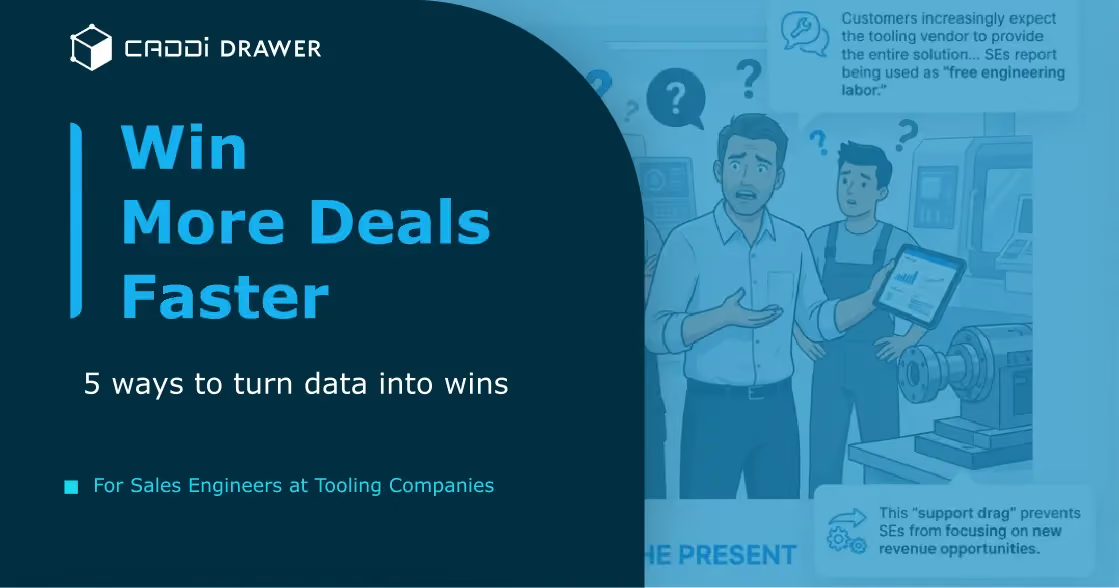
Table of Contents

The role of the Sales Engineer (SE) in American tooling manufacturing has never been more critical—or more challenging. The easy transactional sales are gone, devoured by commoditization and the "Amazon effect" – people expecting turnaround times at the speed of Amazon. Today, you are no longer just selling a cutting tool; you are selling a process, proving technical superiority, and acting as the customer's outsourced engineer.
In this environment, defined by rapid technological shifts, such as the shift to Electric Vehicles (EVs), and persistent skills shortages, success hinges on speed, technical credibility, and consultative value selling. Your customers expect you to solve their most complex manufacturing problems. But how can you move up the value chain when you are constantly stuck in administrative "firefighting" and tedious information searches?
The answer lies in mastering your organization's most valuable, yet often trapped, asset: your historical manufacturing data. By leveraging an AI data platform, you can transform from a field resource chasing data into a strategic "Trusted Advisor" who wins based on undeniable facts and data-driven insights.
Here are five critical challenges facing today's tooling Sales Engineer and how CADDi provides the modern digital tools needed to overcome them.
1. Accelerating "Special" Tool Quoting
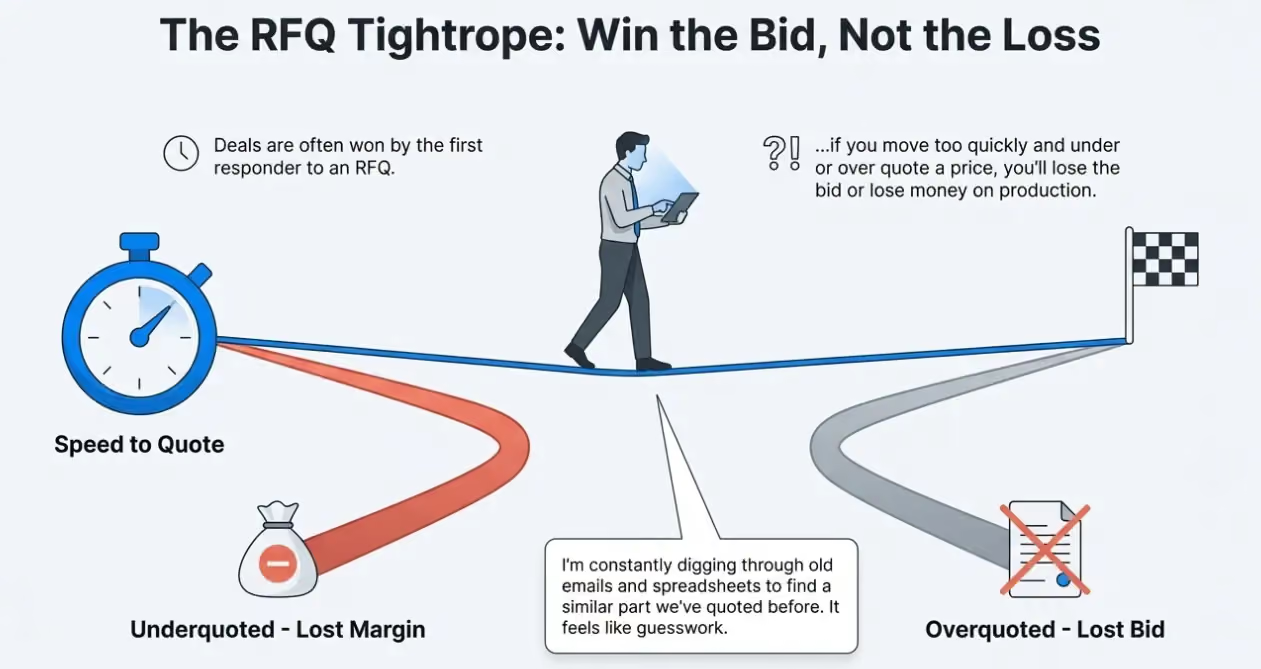
The Challenge: The market is trending toward customized, or "special," tools optimized for specific part geometries, but internal manufacturing plants prefer long runs of standard products. Sales Engineers frequently face long lead times and bureaucratic hurdles when getting these specials quoted, which often kills the deal before it starts. Speed and accuracy in responding to Requests for Quotes (RFQs) are paramount, as being the first bidder often secures the business.
Why It Matters Now: The move toward EVs necessitates specialized tooling for complex aluminum structures and battery casings, making the ability to quickly quote "specials" a key market differentiator. Losing deals due to slow RFQ response times or inconsistent pricing is a massive drain on profitability and market position.
How CADDi Helps: CADDi Drawer and CADDi Quote allow you to instantly surface relevant past pricing information, reducing the hours spent manually comparing drawings and cross-referencing past jobs into minutes. By using CADDi’s patented Similarity Search function, you can upload the customer's drawing and instantly find every geometrically similar part your company has ever handled, along with its associated cost estimates and actual ultimate cost. This data provides the accurate historical benchmark needed for faster quotes, equipping you to respond first and win more profitable RFQs. For more information, check out our resource, Manufacturing Quotation in 2025 - Challenges and Opportunities.
2. Mastering Value Selling and ROI Calculation
The Challenge: The core of modern tooling sales is moving the conversation from "price per insert" to "cost per part". To convince a purchasing manager to pay more for a superior tool, the SE must mathematically prove the return on investment (ROI) by demonstrating lower cycle times or longer tool life. However, gathering the historical performance and costing data needed for this sophisticated calculation is often subjective or requires inefficient trips across internal departments.
Why It Matters Now: With competitors aggressively commoditizing standard items and customers focusing fiercely on profitability, winning high-value deals depends entirely on presenting undeniable, data-backed ROI.
How CADDi Helps: CADDi serves as an AI data platform that intelligently links design drawings with procurement costs, quality data (such as defect rates), and supplier information. This unification of fragmented data allows you to pull objective evidence on the fly. You can easily demonstrate to the customer that while Tool A is cheaper upfront, historical data shows that geometrically similar parts sourced with higher-quality materials (Tool B) result in drastically reduced scrap and rework—proving that Tool B yields a lower total cost per part.
3. Mitigating Knowledge Drain and Consultant Dependency
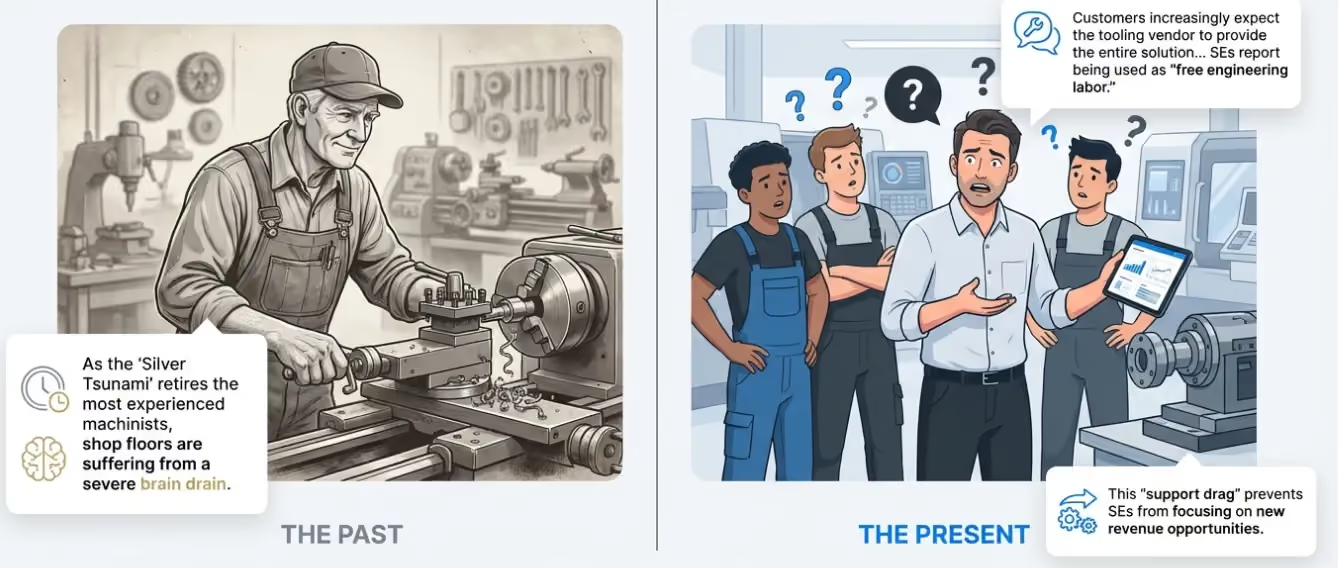
The Challenge: As the "Silver Tsunami" of experienced machinists retires, shops face a severe brain drain, forcing SEs to act as unpaid application engineers and technical consultants. Customers increasingly expect the SE to serve as a "human search engine," asking for information they could often find themselves. This consulting strain consumes massive amounts of time that should be spent on prospecting and closing new business.
Why It Matters Now: The burden of education and support drag prevents SEs from scaling their efforts, reducing their overall selling time and profitability. Knowledge loss is one of the top pressures facing U.S. manufacturers.
How CADDi Helps: CADDi acts as a "digital mentor" for both your internal teams and your external sales support efforts. By creating a centralized repository for drawings and linked data, CADDi democratizes institutional knowledge. Instead of interrupting a senior engineer or relying on memory, the SE can use intuitive search capabilities (like keyword or sketch search) to instantly retrieve proven designs, process notes, and historical application insights, freeing up valuable time for high-touch value selling. See how CADDi addresses this challenge in our resource, The Labor Paradox: Navigating Manufacturing's Unsettling Reality.
4. Overcoming Cross-Functional Friction
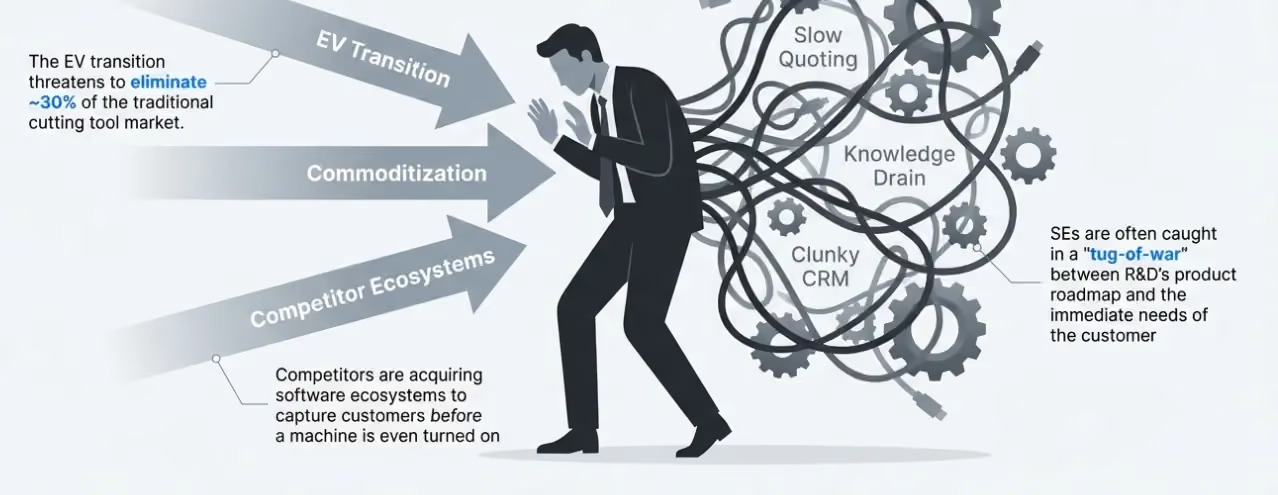
The Challenge: Sales Engineers are often caught in an internal "tug-of-war" between external customer demands and internal bureaucracy (R&D, Production Planning). Designs for "specials" often face long lead times because R&D and manufacturing are disconnected, operating in silos and failing to standardize common parts or geometries. This internal friction drives up costs and delays launches.
Why It Matters Now: The need for agility and fast iteration in tooling development requires seamless cross-functional collaboration. Disconnected teams lead to redundancies, inconsistent decisions, and unnecessary engineering work.
How CADDi Helps: CADDi functions as an AI-driven data lake that breaks down data silos across Engineering, Procurement, and Sales. It connects CAD files, quality defect reports, and purchasing data around the common medium of the drawing. This single source of truth allows the SE to instantly verify if a similar part already exists (design reuse), preventing the costly proliferation of redundant designs, and facilitating design standardization efforts championed by Engineering and Procurement.
5. Pivoting Design Strategy for the EV Market
The Challenge: The EV transition requires tooling manufacturers to pivot their design strategy toward complex structural components made of aluminum and composite materials, replacing the high-volume traditional steel powertrain parts. This shift demands agility to develop and source new, specialized tool geometries, often requiring iterative design and Value Analysis/Value Engineering (VA/VE).
Why It Matters Now: Successfully pivoting to new material mastery is crucial for securing long-term growth and offsetting the estimated 30% reduction in the traditional cutting tool market.
How CADDi Helps: CADDi accelerates Value Analysis/Value Engineering (VA/VE) initiatives by using similarity search to uncover opportunities for cost savings and design optimization without sacrificing quality. By instantly comparing new design requirements for EV parts against historical successful and unsuccessful geometries, engineers can accelerate new product development. This data-driven approach allows your R&D teams to quickly identify the most cost-effective materials and design features for new EV components, ensuring your company remains technically superior in this high-value market. Learn more about this core function in our resource, Reduce costs, not quality: Use VA/VE to uncover opportunities for efficiency.
The modern Sales Engineer is not just selling physical products; they are selling efficiency, risk mitigation, and proven performance. By providing your teams with an AI platform that turns dormant drawings and scattered procurement data into actionable intelligence, you equip them to transition from a reactive "order taker" to a strategic "Trusted Advisor". This is how leading tooling manufacturers are leveraging data to reduce friction, accelerate deals, and dominate the high-value segment of the market.
Ready to see how CADDi can transform your sales process into a consultative advantage?
Book a Demo to see CADDi Drawer and CADDi Quote in action today!.
The role of the Sales Engineer (SE) in American tooling manufacturing has never been more critical—or more challenging. The easy transactional sales are gone, devoured by commoditization and the "Amazon effect" – people expecting turnaround times at the speed of Amazon. Today, you are no longer just selling a cutting tool; you are selling a process, proving technical superiority, and acting as the customer's outsourced engineer.
In this environment, defined by rapid technological shifts, such as the shift to Electric Vehicles (EVs), and persistent skills shortages, success hinges on speed, technical credibility, and consultative value selling. Your customers expect you to solve their most complex manufacturing problems. But how can you move up the value chain when you are constantly stuck in administrative "firefighting" and tedious information searches?
The answer lies in mastering your organization's most valuable, yet often trapped, asset: your historical manufacturing data. By leveraging an AI data platform, you can transform from a field resource chasing data into a strategic "Trusted Advisor" who wins based on undeniable facts and data-driven insights.
Here are five critical challenges facing today's tooling Sales Engineer and how CADDi provides the modern digital tools needed to overcome them.
1. Accelerating "Special" Tool Quoting
The Challenge: The market is trending toward customized, or "special," tools optimized for specific part geometries, but internal manufacturing plants prefer long runs of standard products. Sales Engineers frequently face long lead times and bureaucratic hurdles when getting these specials quoted, which often kills the deal before it starts. Speed and accuracy in responding to Requests for Quotes (RFQs) are paramount, as being the first bidder often secures the business.
Why It Matters Now: The move toward EVs necessitates specialized tooling for complex aluminum structures and battery casings, making the ability to quickly quote "specials" a key market differentiator. Losing deals due to slow RFQ response times or inconsistent pricing is a massive drain on profitability and market position.
How CADDi Helps: CADDi Drawer and CADDi Quote allow you to instantly surface relevant past pricing information, reducing the hours spent manually comparing drawings and cross-referencing past jobs into minutes. By using CADDi’s patented Similarity Search function, you can upload the customer's drawing and instantly find every geometrically similar part your company has ever handled, along with its associated cost estimates and actual ultimate cost. This data provides the accurate historical benchmark needed for faster quotes, equipping you to respond first and win more profitable RFQs. For more information, check out our resource, Manufacturing Quotation in 2025 - Challenges and Opportunities.
2. Mastering Value Selling and ROI Calculation
The Challenge: The core of modern tooling sales is moving the conversation from "price per insert" to "cost per part". To convince a purchasing manager to pay more for a superior tool, the SE must mathematically prove the return on investment (ROI) by demonstrating lower cycle times or longer tool life. However, gathering the historical performance and costing data needed for this sophisticated calculation is often subjective or requires inefficient trips across internal departments.
Why It Matters Now: With competitors aggressively commoditizing standard items and customers focusing fiercely on profitability, winning high-value deals depends entirely on presenting undeniable, data-backed ROI.
How CADDi Helps: CADDi serves as an AI data platform that intelligently links design drawings with procurement costs, quality data (such as defect rates), and supplier information. This unification of fragmented data allows you to pull objective evidence on the fly. You can easily demonstrate to the customer that while Tool A is cheaper upfront, historical data shows that geometrically similar parts sourced with higher-quality materials (Tool B) result in drastically reduced scrap and rework—proving that Tool B yields a lower total cost per part.
3. Mitigating Knowledge Drain and Consultant Dependency
The Challenge: As the "Silver Tsunami" of experienced machinists retires, shops face a severe brain drain, forcing SEs to act as unpaid application engineers and technical consultants. Customers increasingly expect the SE to serve as a "human search engine," asking for information they could often find themselves. This consulting strain consumes massive amounts of time that should be spent on prospecting and closing new business.
Why It Matters Now: The burden of education and support drag prevents SEs from scaling their efforts, reducing their overall selling time and profitability. Knowledge loss is one of the top pressures facing U.S. manufacturers.
How CADDi Helps: CADDi acts as a "digital mentor" for both your internal teams and your external sales support efforts. By creating a centralized repository for drawings and linked data, CADDi democratizes institutional knowledge. Instead of interrupting a senior engineer or relying on memory, the SE can use intuitive search capabilities (like keyword or sketch search) to instantly retrieve proven designs, process notes, and historical application insights, freeing up valuable time for high-touch value selling. See how CADDi addresses this challenge in our resource, The Labor Paradox: Navigating Manufacturing's Unsettling Reality.
4. Overcoming Cross-Functional Friction
The Challenge: Sales Engineers are often caught in an internal "tug-of-war" between external customer demands and internal bureaucracy (R&D, Production Planning). Designs for "specials" often face long lead times because R&D and manufacturing are disconnected, operating in silos and failing to standardize common parts or geometries. This internal friction drives up costs and delays launches.
Why It Matters Now: The need for agility and fast iteration in tooling development requires seamless cross-functional collaboration. Disconnected teams lead to redundancies, inconsistent decisions, and unnecessary engineering work.
How CADDi Helps: CADDi functions as an AI-driven data lake that breaks down data silos across Engineering, Procurement, and Sales. It connects CAD files, quality defect reports, and purchasing data around the common medium of the drawing. This single source of truth allows the SE to instantly verify if a similar part already exists (design reuse), preventing the costly proliferation of redundant designs, and facilitating design standardization efforts championed by Engineering and Procurement.
5. Pivoting Design Strategy for the EV Market
The Challenge: The EV transition requires tooling manufacturers to pivot their design strategy toward complex structural components made of aluminum and composite materials, replacing the high-volume traditional steel powertrain parts. This shift demands agility to develop and source new, specialized tool geometries, often requiring iterative design and Value Analysis/Value Engineering (VA/VE).
Why It Matters Now: Successfully pivoting to new material mastery is crucial for securing long-term growth and offsetting the estimated 30% reduction in the traditional cutting tool market.
How CADDi Helps: CADDi accelerates Value Analysis/Value Engineering (VA/VE) initiatives by using similarity search to uncover opportunities for cost savings and design optimization without sacrificing quality. By instantly comparing new design requirements for EV parts against historical successful and unsuccessful geometries, engineers can accelerate new product development. This data-driven approach allows your R&D teams to quickly identify the most cost-effective materials and design features for new EV components, ensuring your company remains technically superior in this high-value market. Learn more about this core function in our resource, Reduce costs, not quality: Use VA/VE to uncover opportunities for efficiency.
The modern Sales Engineer is not just selling physical products; they are selling efficiency, risk mitigation, and proven performance. By providing your teams with an AI platform that turns dormant drawings and scattered procurement data into actionable intelligence, you equip them to transition from a reactive "order taker" to a strategic "Trusted Advisor". This is how leading tooling manufacturers are leveraging data to reduce friction, accelerate deals, and dominate the high-value segment of the market.
Ready to see how CADDi can transform your sales process into a consultative advantage?
Book a Demo to see CADDi Drawer and CADDi Quote in action today!.
Ready to see CADDi Drawer in action? Get a personalized demo.
Subscribe to our Blog!
.svg)
.svg)
.svg)

Related Resources