.svg)

Stop Reinventing the Wheel: How AI Data Unlocks Critical Efficiency for American Automotive Manufacturing Engineers

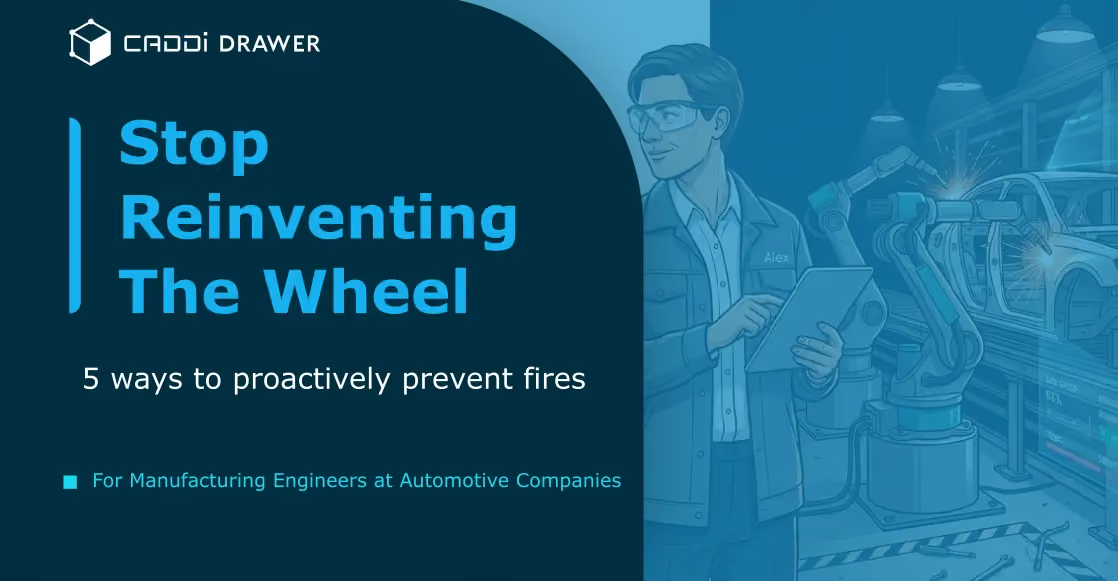
Table of Contents

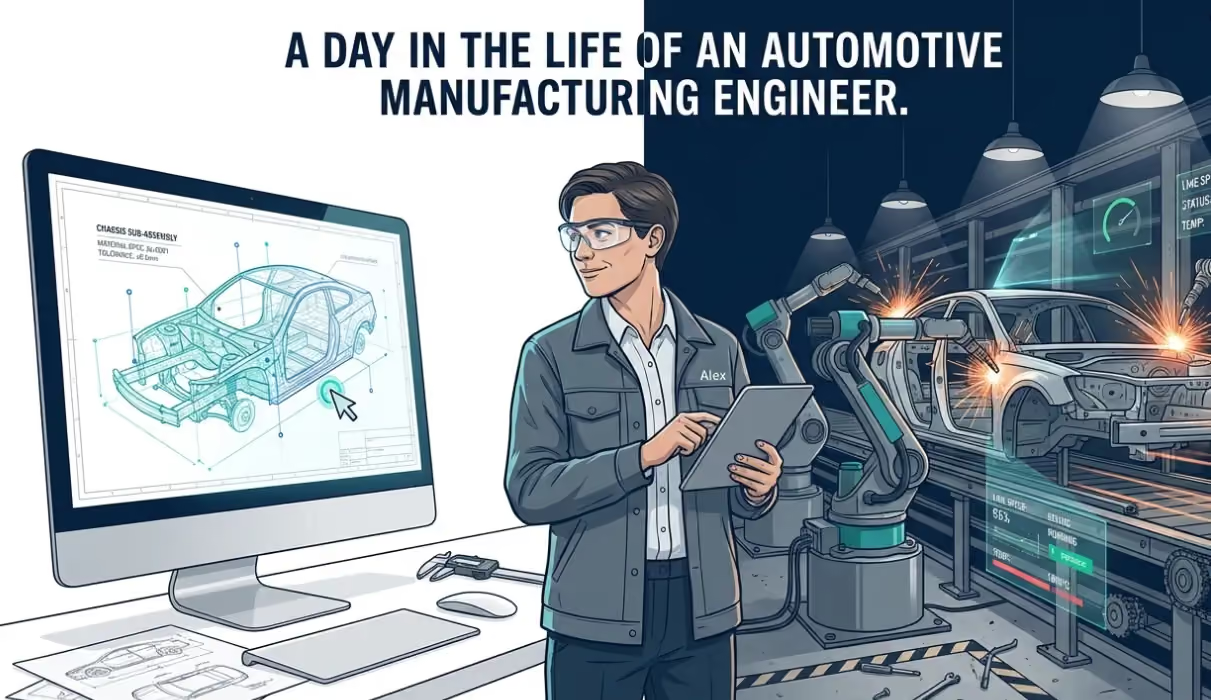
The American automotive sector is facing a monumental challenge: pivoting to the future of CASE (Connected, Autonomous/Automated, Shared, Electric) while simultaneously grappling with unprecedented cost pressure and labor shortages. Manufacturing Engineers (MEs) working on the factory floor and launching new programs stand at the critical intersection of design and reality. They are tasked with ensuring designs are manufacturable, processes are optimized, and the line keeps moving, all under intense cost-down and launch timing pressure.
The reality, however, is that much of their day is spent trapped in a cycle of reactive "firefighting" and tedious administrative friction—chasing down missing drawings, recreating fixtures because past designs are invisible, or translating "tribal knowledge" into process documentation. This reality is why the digital tools we rely on must evolve beyond mere record-keeping (like legacy PLM/ERP) and become true Systems of Insight.
CADDi, an AI data platform for manufacturing, is designed specifically to remove this systemic friction, transforming our fragmented product data—from decades of 2D drawings to real-time quality reports—into an actionable asset. By linking this data intelligently around the engineering drawing itself, CADDi empowers MEs to focus on strategic initiatives like cost reduction and process optimization rather than administrative drudgery.
Here are five critical challenges facing American Automotive Manufacturing Engineers today and how leveraging a modern AI data platform like CADDi can provide immediate, measurable relief:
1. Tooling Chaos and Fixture Standardization
The Challenge: Between frequent program launches (for both EV and ICE platforms) and constant design revisions, Manufacturing Engineers frequently encounter tooling chaos and fixture duplication. They waste valuable time either designing new jigs and routings from scratch or searching through disorganized repositories for proven, similar tooling used in past programs. This duplication adds unnecessary cost and complexity to the shop floor.
Why Now: With immense pressure on launch timing and fixed resources, manually vetting, reusing, or recreating fixtures introduces significant delays to the PPAP and First Article Inspection (FAI) processes. The inability to standardize means manufacturing resources are inefficiently deployed.
How CADDi Helps: CADDi Drawer uses patented similarity search technology, recognizing the shape and geometry of parts from drawings, to instantly find every similar component and assembly ever manufactured. An ME can search with a new part drawing and immediately retrieve historical drawings, jigs, and routings used for functionally similar parts. This capability:
- Accelerates standardization efforts by identifying where slight variations in design have led to unnecessary part proliferation.
- Enables CAM data reuse for nearly identical parts, saving crucial programming time.
- Reduces friction by allowing the team to lean on CADDi to confirm if a fixture already exists, avoiding taxing the design department with duplicate requests.
2. Ending the Design vs. Manufacturing Schism (DFM)
The Challenge: A persistent, structural conflict exists between Product Design and Manufacturing Engineering, where MEs often receive designs "over the wall" that have unrealistic tolerances or are simply unbuildable with current assembly feasibility limitations. This "Engineering Schism" drives up costs and delays vehicle launches.
Why Now: Achieving Design for Manufacturability (DFM) proficiency is paramount. Automotive components are increasingly complex, and every design decision in the upstream engineering chain determines approximately 80% of the final product’s cost. Delayed manufacturability reviews are no longer sustainable.
How CADDi Helps: CADDi is designed to enhance cross-functional collaboration by unifying fragmented data. CADDi Drawer acts as a central data foundation, consolidating engineering drawings, purchasing data, process information, and manufacturing work instructions into a single platform accessible to all departments. This convergence helps:
- Force early collaboration by making cost, supplier, and manufacturability context available to Design Engineering.
- Bridge the gap between creators and users of drawings.
- The similarity search feature allows MEs to access manufacturing information and cost breakdowns applied by experienced engineers on drawings with similar characteristics, transforming DFM from an argument into a data-driven science.
3. Moving from Firefighting to Predictive Quality
The Challenge: MEs are often caught in a reactive cycle, becoming "heroes" when they fix a broken line at 2:00 AM, rather than focusing on the proactive systemic changes that prevent the issue from occurring. Poor visibility into part history or prior fixes means the same defect or downtime issue recurs across programs. Quality data is often trapped in a silo away from the initial design and process documentation.
Why Now: Automotive KPIs heavily favor First Pass Yield (FPY) and Scrap Rate. As validation windows shorten for new EV platforms, moving from reactive to predictive quality is critical to reducing costly scrap, rework, and warranty claims.
How CADDi Helps: CADDi functions as a System of Insight by linking quality data directly to the part drawing. When a quality issue arises, CADDi enables proactive risk assessment:
- It breaks down siloed data structures, allowing you to link supplier data, purchasing data, quality data, and documents to drawings.
- A Quality Manager can use CADDi’s similarity search to instantly find every other part in the portfolio with similar geometric features, material specifications, or tolerances that might be at risk, rather than waiting for a failure.
- This insight allows MEs to proactively address potential issues before they lead to widespread failure or massive rework costs, shifting the focus from "firefighting" to systemic prevention.
4. Mitigating Knowledge Drain and Accelerating Onboarding
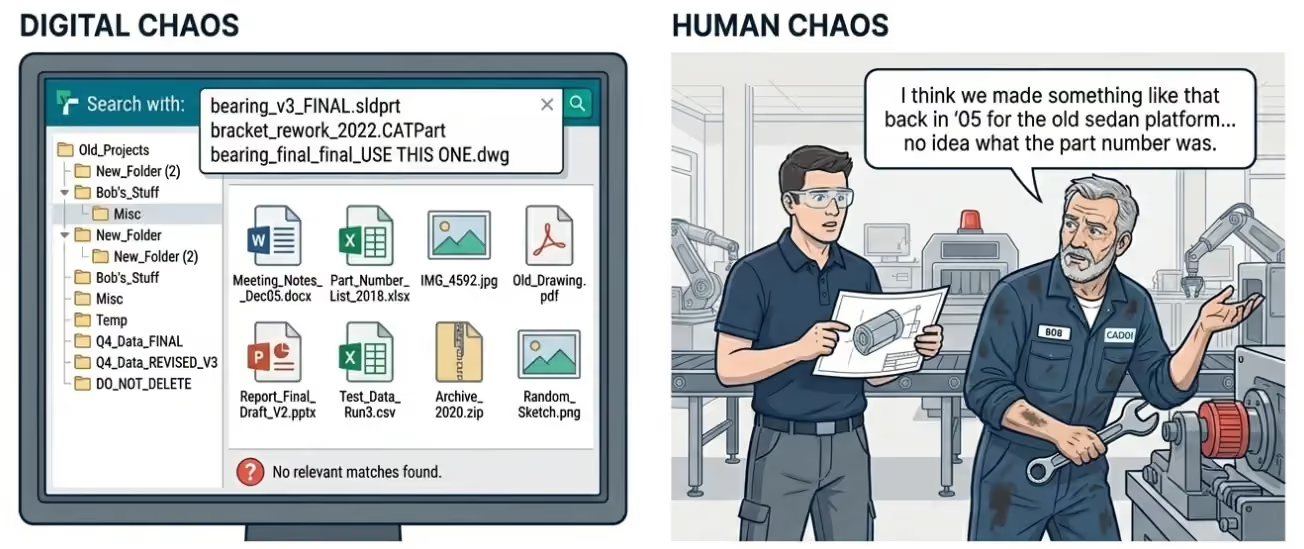
The Challenge: Manufacturing Engineers act as a generational buffer, struggling to translate the deep, unwritten "tribal knowledge" of retiring veterans into formats usable by digital-native new hires. This knowledge drain results in long, inefficient onboarding times, where new hires struggle to navigate the company’s vast and disorganized design history.
Why Now: The persistent shortage of skilled labor means every new hire must reach productivity faster. Up to 68% of senior manufacturing leaders believe at least half of their institutional knowledge will be lost upon retirement.
How CADDi Helps: CADDi is explicitly designed to address this talent and knowledge crisis.
- It acts as an AI-driven "digital mentor" for new personnel, providing instant and intuitive access to institutional IP.
- The system uses AI to analyze drawings, making them searchable by criteria like shape, material, or keyword (e.g., searching for "bumper" to instantly surface relevant drawings), eliminating the reliance on memorized part IDs.
- By democratizing this knowledge, CADDi accelerates time-to-productivity for new engineering and procurement hires, reducing the burden on senior staff who can then focus on higher-value tasks.
5. Driving Data-Driven Value Analysis/Value Engineering (VA/VE)
The Challenge: We are under constant mandate to find 3% or more in annual cost-down opportunities. Value Analysis/Value Engineering (VA/VE) initiatives are the key to cost optimization, but they are often complex and time-intensive. Analyzing the entire supply chain and design history to find cheaper alternatives or unnecessary cost drivers is nearly impossible using manual processes or siloed ERP data.
Why Now: Cost mitigation is the number one concern for manufacturing leadership. VA/VE is the process by which MEs can optimize the 80% of product cost determined by design.
How CADDi Helps: CADDi provides the necessary data foundation to make VA/VE a continuous, high-ROI process.
- The system links drawings with purchase costs, quality data, and supplier information.
- CADDi’s similarity search helps MEs quickly find similar parts across their entire archive and compare their associated costs.
- By flagging similar parts with significant price differences, MEs can immediately begin analysis to determine if the cost variation is due to an over-engineered tolerance, a more expensive material, or a suboptimal supplier. This empowers the ME to guide redesigns that maintain functionality while minimizing unnecessary cost.
Conclusion: Leveraging Your Data Foundation
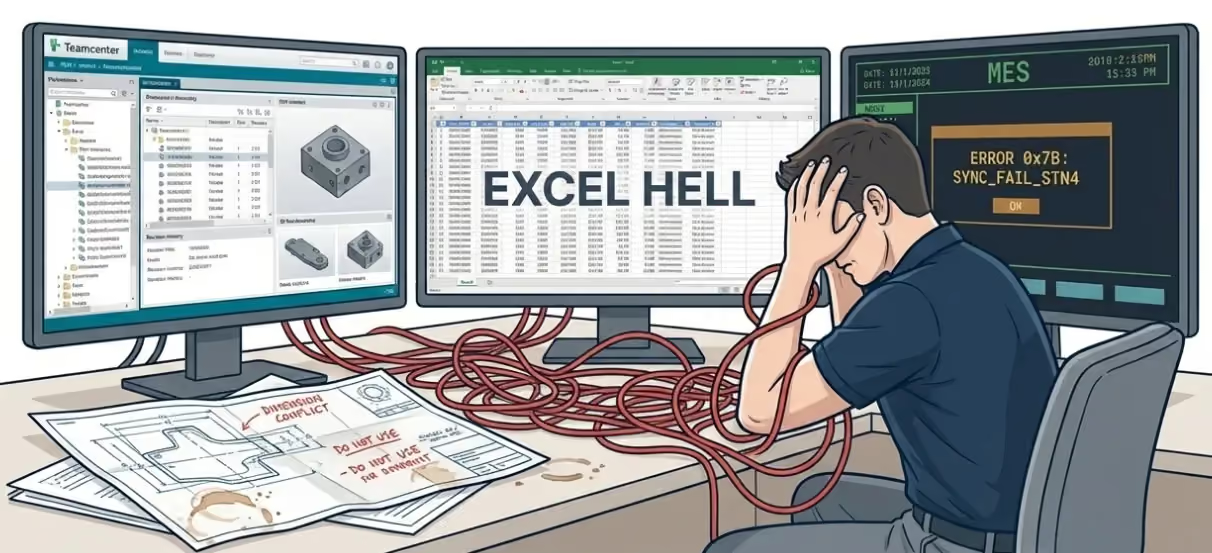
The modern Manufacturing Engineer cannot be chained to Excel Hell or constantly fighting fires caused by fragmented data. Our greatest opportunity for competitive advantage—for meeting launch timelines and hitting cost targets—lies in transforming our fragmented legacy data into a strategic asset.
CADDi Drawer provides the foundational System of Insight necessary to break down data silos across engineering, procurement, and production. It enables MEs to move faster, design smarter, and become the strategic architects of the next century of American automotive manufacturing.
Ready to see how fast you can find and reuse your company's most valuable design and process knowledge? Book a Demo today to explore the power of CADDi Drawer.
For further reading on cost reduction in engineering, see CADDi’s white paper: Reduce costs, not quality: Use VA/VE to uncover opportunities for efficiency
To learn more about accelerating knowledge transfer, explore: The Labor Paradox: Navigating Manufacturing's Unsettling Reality
The American automotive sector is facing a monumental challenge: pivoting to the future of CASE (Connected, Autonomous/Automated, Shared, Electric) while simultaneously grappling with unprecedented cost pressure and labor shortages. Manufacturing Engineers (MEs) working on the factory floor and launching new programs stand at the critical intersection of design and reality. They are tasked with ensuring designs are manufacturable, processes are optimized, and the line keeps moving, all under intense cost-down and launch timing pressure.
The reality, however, is that much of their day is spent trapped in a cycle of reactive "firefighting" and tedious administrative friction—chasing down missing drawings, recreating fixtures because past designs are invisible, or translating "tribal knowledge" into process documentation. This reality is why the digital tools we rely on must evolve beyond mere record-keeping (like legacy PLM/ERP) and become true Systems of Insight.
CADDi, an AI data platform for manufacturing, is designed specifically to remove this systemic friction, transforming our fragmented product data—from decades of 2D drawings to real-time quality reports—into an actionable asset. By linking this data intelligently around the engineering drawing itself, CADDi empowers MEs to focus on strategic initiatives like cost reduction and process optimization rather than administrative drudgery.
Here are five critical challenges facing American Automotive Manufacturing Engineers today and how leveraging a modern AI data platform like CADDi can provide immediate, measurable relief:
1. Tooling Chaos and Fixture Standardization
The Challenge: Between frequent program launches (for both EV and ICE platforms) and constant design revisions, Manufacturing Engineers frequently encounter tooling chaos and fixture duplication. They waste valuable time either designing new jigs and routings from scratch or searching through disorganized repositories for proven, similar tooling used in past programs. This duplication adds unnecessary cost and complexity to the shop floor.
Why Now: With immense pressure on launch timing and fixed resources, manually vetting, reusing, or recreating fixtures introduces significant delays to the PPAP and First Article Inspection (FAI) processes. The inability to standardize means manufacturing resources are inefficiently deployed.
How CADDi Helps: CADDi Drawer uses patented similarity search technology, recognizing the shape and geometry of parts from drawings, to instantly find every similar component and assembly ever manufactured. An ME can search with a new part drawing and immediately retrieve historical drawings, jigs, and routings used for functionally similar parts. This capability:
- Accelerates standardization efforts by identifying where slight variations in design have led to unnecessary part proliferation.
- Enables CAM data reuse for nearly identical parts, saving crucial programming time.
- Reduces friction by allowing the team to lean on CADDi to confirm if a fixture already exists, avoiding taxing the design department with duplicate requests.
2. Ending the Design vs. Manufacturing Schism (DFM)
The Challenge: A persistent, structural conflict exists between Product Design and Manufacturing Engineering, where MEs often receive designs "over the wall" that have unrealistic tolerances or are simply unbuildable with current assembly feasibility limitations. This "Engineering Schism" drives up costs and delays vehicle launches.
Why Now: Achieving Design for Manufacturability (DFM) proficiency is paramount. Automotive components are increasingly complex, and every design decision in the upstream engineering chain determines approximately 80% of the final product’s cost. Delayed manufacturability reviews are no longer sustainable.
How CADDi Helps: CADDi is designed to enhance cross-functional collaboration by unifying fragmented data. CADDi Drawer acts as a central data foundation, consolidating engineering drawings, purchasing data, process information, and manufacturing work instructions into a single platform accessible to all departments. This convergence helps:
- Force early collaboration by making cost, supplier, and manufacturability context available to Design Engineering.
- Bridge the gap between creators and users of drawings.
- The similarity search feature allows MEs to access manufacturing information and cost breakdowns applied by experienced engineers on drawings with similar characteristics, transforming DFM from an argument into a data-driven science.
3. Moving from Firefighting to Predictive Quality
The Challenge: MEs are often caught in a reactive cycle, becoming "heroes" when they fix a broken line at 2:00 AM, rather than focusing on the proactive systemic changes that prevent the issue from occurring. Poor visibility into part history or prior fixes means the same defect or downtime issue recurs across programs. Quality data is often trapped in a silo away from the initial design and process documentation.
Why Now: Automotive KPIs heavily favor First Pass Yield (FPY) and Scrap Rate. As validation windows shorten for new EV platforms, moving from reactive to predictive quality is critical to reducing costly scrap, rework, and warranty claims.
How CADDi Helps: CADDi functions as a System of Insight by linking quality data directly to the part drawing. When a quality issue arises, CADDi enables proactive risk assessment:
- It breaks down siloed data structures, allowing you to link supplier data, purchasing data, quality data, and documents to drawings.
- A Quality Manager can use CADDi’s similarity search to instantly find every other part in the portfolio with similar geometric features, material specifications, or tolerances that might be at risk, rather than waiting for a failure.
- This insight allows MEs to proactively address potential issues before they lead to widespread failure or massive rework costs, shifting the focus from "firefighting" to systemic prevention.
4. Mitigating Knowledge Drain and Accelerating Onboarding
The Challenge: Manufacturing Engineers act as a generational buffer, struggling to translate the deep, unwritten "tribal knowledge" of retiring veterans into formats usable by digital-native new hires. This knowledge drain results in long, inefficient onboarding times, where new hires struggle to navigate the company’s vast and disorganized design history.
Why Now: The persistent shortage of skilled labor means every new hire must reach productivity faster. Up to 68% of senior manufacturing leaders believe at least half of their institutional knowledge will be lost upon retirement.
How CADDi Helps: CADDi is explicitly designed to address this talent and knowledge crisis.
- It acts as an AI-driven "digital mentor" for new personnel, providing instant and intuitive access to institutional IP.
- The system uses AI to analyze drawings, making them searchable by criteria like shape, material, or keyword (e.g., searching for "bumper" to instantly surface relevant drawings), eliminating the reliance on memorized part IDs.
- By democratizing this knowledge, CADDi accelerates time-to-productivity for new engineering and procurement hires, reducing the burden on senior staff who can then focus on higher-value tasks.
5. Driving Data-Driven Value Analysis/Value Engineering (VA/VE)
The Challenge: We are under constant mandate to find 3% or more in annual cost-down opportunities. Value Analysis/Value Engineering (VA/VE) initiatives are the key to cost optimization, but they are often complex and time-intensive. Analyzing the entire supply chain and design history to find cheaper alternatives or unnecessary cost drivers is nearly impossible using manual processes or siloed ERP data.
Why Now: Cost mitigation is the number one concern for manufacturing leadership. VA/VE is the process by which MEs can optimize the 80% of product cost determined by design.
How CADDi Helps: CADDi provides the necessary data foundation to make VA/VE a continuous, high-ROI process.
- The system links drawings with purchase costs, quality data, and supplier information.
- CADDi’s similarity search helps MEs quickly find similar parts across their entire archive and compare their associated costs.
- By flagging similar parts with significant price differences, MEs can immediately begin analysis to determine if the cost variation is due to an over-engineered tolerance, a more expensive material, or a suboptimal supplier. This empowers the ME to guide redesigns that maintain functionality while minimizing unnecessary cost.
Conclusion: Leveraging Your Data Foundation
The modern Manufacturing Engineer cannot be chained to Excel Hell or constantly fighting fires caused by fragmented data. Our greatest opportunity for competitive advantage—for meeting launch timelines and hitting cost targets—lies in transforming our fragmented legacy data into a strategic asset.
CADDi Drawer provides the foundational System of Insight necessary to break down data silos across engineering, procurement, and production. It enables MEs to move faster, design smarter, and become the strategic architects of the next century of American automotive manufacturing.
Ready to see how fast you can find and reuse your company's most valuable design and process knowledge? Book a Demo today to explore the power of CADDi Drawer.
For further reading on cost reduction in engineering, see CADDi’s white paper: Reduce costs, not quality: Use VA/VE to uncover opportunities for efficiency
To learn more about accelerating knowledge transfer, explore: The Labor Paradox: Navigating Manufacturing's Unsettling Reality
Ready to see CADDi Drawer in action? Get a personalized demo.
Subscribe to our Blog!
.svg)
.svg)
.svg)