.svg)

Operational Excellence in Automotive: 5 Data Strategies to End the EV Firefighting Cycle

Table of Contents

The American automotive manufacturing sector is operating under immense pressure. Manufacturing Engineers (MEs) and Operations leaders are tasked with the urgent, complex challenge of navigating the EV transition while combating volatility, cost-down mandates, and a pervasive "firefighting" culture. The shift to electric vehicles (EVs) fundamentally changes the factory floor, moving production away from mechanical systems (transmissions, engines) and toward complex electrochemical and high-voltage architectures.
In this environment, relying on manual processes or fragmented data is a guaranteed recipe for failure. Operational excellence now mandates structural resilience and agility, achievable only by unifying your enterprise data. You must transform your scattered historical intellectual property (IP) from a dormant archive into an actionable System of Insight.
Here are five acute operational challenges facing automotive manufacturers and how CADDi provides the digital foundation needed to turn them into competitive advantages.
1. Eliminating Fragmented Visibility and "Excel Hell"
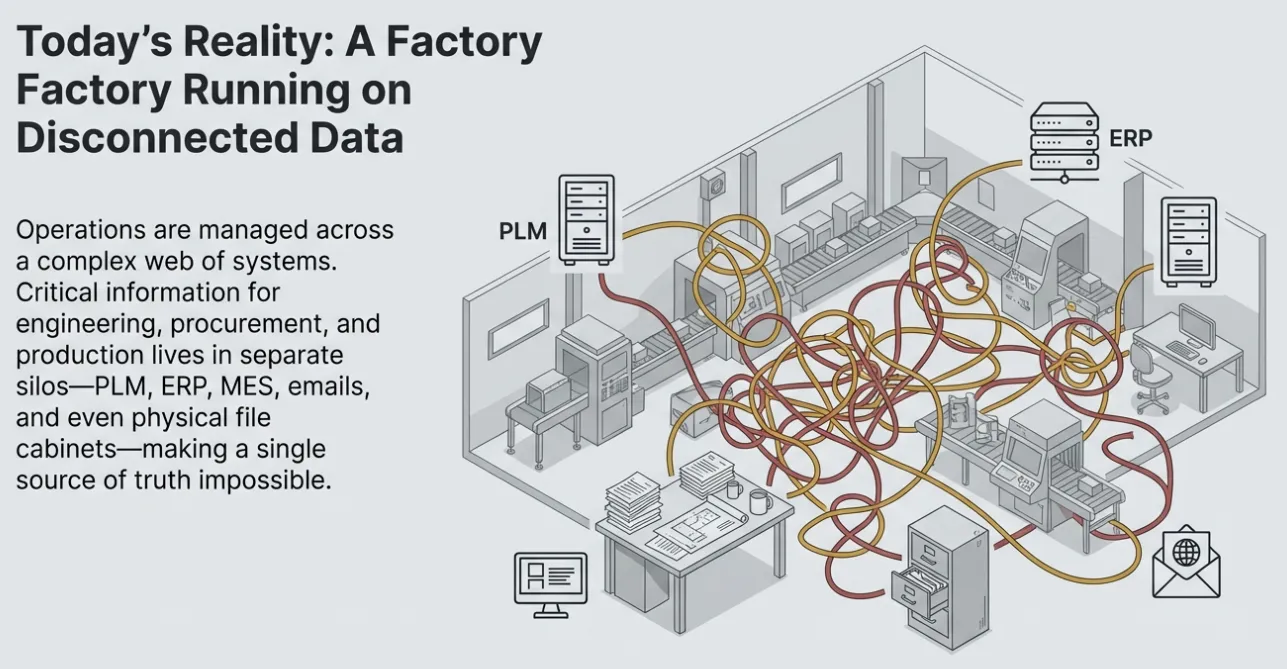
The Challenge: Despite multi-million dollar investments in Enterprise Resource Planning (ERP) and Product Lifecycle Management (PLM) systems, the factory floor often runs on a fragile, disconnected infrastructure. Critical production insights are trapped in local spreadsheets ("Excel Hell") or departmental silos, creating fragmented visibility that prevents a holistic view of operations. This forces MEs into reactive crisis management.
Why It Matters Now: Volatility in the geopolitical environment and supply chain demands real-time, granular visibility to anticipate and respond to disruptions. Relying on fragmented data creates substantial risk for new product launches and prevents compliance with complex traceability requirements.
How CADDi Helps: CADDi Drawer functions as an AI-driven data lake that fundamentally breaks down data silos. It uses the design drawing as the indispensable anchor point to link purchasing data (ERP), quality reports, CAM files, and legacy documents. By centralizing this disparate information into a single source of truth, CADDi delivers the complete, connected product record necessary for informed, proactive decision-making across the entire automotive lifecycle.
2. Mitigating Launch Disruption and Quality Risk
The Challenge: New program launches often suffer from instability, rework, and costly delays due to incomplete or outdated specifications and a lack of traceability between design decisions, supplier materials, and final Quality Assurance (QA) data. When a component defect is discovered, identifying the root cause across multi-year production runs and diverse suppliers is manually intensive and slow.
Why It Matters Now: Shorter EV validation windows increase defect risk, especially when introducing high-voltage components. The cost of component defects and subsequent recalls often vastly overshadows any initial procurement savings. Manufacturers must pivot from reactive quality failure management to a proactive, data-driven system.
How CADDi Helps: CADDi significantly enhances quality control by linking quality defect reports directly to design drawings and supplier histories. When a quality issue arises with one part, the patented similarity search instantly finds every other drawing in the system with similar geometric features or materials. This allows MEs and Quality teams to proactively assess risk across their entire product portfolio and prevent catastrophic recalls, thereby reducing scrap, rework, and warranty claims. Customers using CADDi have reported a 15% improvement in defect rate. For more information, see our resource, From Reactive to Predictive: Using Historical Data to Reduce Scrap, Rework, and Warranty Claims.
3. Bridging the EV Competency Gap and Knowledge Drain
The Challenge: The automotive sector faces a dual crisis: the structural loss of institutional knowledge as veteran mechanical engineers retire, and the urgent need to acquire new skills for EV systems. The inability to effectively capture and transfer tacit knowledge leaves the remaining workforce struggling with legacy designs and long onboarding times.
Why It Matters Now: The industry faces a severe labor shortage, making efficiency gains equivalent to increasing headcount capacity. Accelerating the competence curve for new hires is a mandatory strategy for mitigating this crisis.
How CADDi Helps: CADDi acts as an AI-driven "digital mentor" for new technical staff. By digitizing and centralizing decades of fragmented technical IP—including handwritten and legacy 2D drawings—it creates a unified institutional knowledge repository. New hires can use similarity search to instantly access past projects, understand design intent, and see how parts were sourced and costed. This capability structurally addresses the skills gap, resulting in an observed 84% reduction in the time required for new team members to become productive. For more on this topic, read The Labor Paradox: Navigating Manufacturing's Unsettling Reality.

4. Resolving Cross-Functional Friction for Cost-Down Mandates
The Challenge: A persistent "Over-the-Wall" culture exists where Product Design throws unbuildable or overly expensive designs to Manufacturing and Procurement. This friction, stemming from misaligned priorities (performance vs. cost), forces MEs to design complex, costly tooling just to compensate for designs that were not optimized for manufacturability.
Why It Matters Now: Cost-down mandates are severe, exacerbated by tariffs and EV capital expenditure. MEs must implement genuine Design for Manufacturing/Assembly (DFM/A) or Design-to-Cost (DTC) to achieve the aggressive cost reductions required for corporate survival.
How CADDi Helps: CADDi facilitates Value Analysis/Value Engineering (VA/VE) initiatives by providing the necessary cross-functional data linkage. By unifying drawing data with associated historical procurement and cost data, MEs can quickly identify components that are gold-plated or over-specified. This enables rapid, data-backed negotiations and design changes that reduce costs without sacrificing technical integrity, positioning the organization to capture the significant financial cushioning needed against external pressures. For tools to drive this initiative, see our resource, Reduce costs, not quality: Use VA/VE to uncover opportunities for efficiency.

5. Ending the Redundancy Tax and Parts Proliferation
The Challenge: Design Engineers often default to creating new parts instead of searching for existing ones, leading to costly and unnecessary parts proliferation. This duplication of effort creates a costly "redundancy tax" on the organization through inflated procurement overhead, unnecessary tooling costs, and higher scrap rates.
Why It Matters Now: Program variability driven by EV platforms and variant complexity accelerates this proliferation. Eliminating this structural waste is critical for freeing up capacity in a tight labor market and optimizing inventory.
How CADDi Helps: CADDi uses its patented AI machine vision technology to enable geometry- and dimension-based similarity search. This allows MEs and engineers to instantly find existing designs that meet their specifications. By efficiently identifying and reusing existing parts, the platform directly combats parts proliferation, maximizing design reuse and eliminating redundant tooling and inventory management costs. The capability to save 300 hours per month in drawing search time directly translates to increased capacity for the existing ME workforce.
The modern automotive Operations leader must replace reactive firefighting with proactive, data-driven excellence. By implementing an AI data platform that structurally addresses siloed data, knowledge drain, and design redundancy, you equip your team to handle the complexities of the EV transition while ensuring measurable cost savings. You move your organization from merely surviving volatility to achieving antifragility.

Ready to transform your factory floor and end the firefighting cycle?
Book a Demo to see how CADDi Drawer delivers quantifiable operational efficiency and cost reduction, including the $6.5 million direct cost reduction achieved by Subaru.
The American automotive manufacturing sector is operating under immense pressure. Manufacturing Engineers (MEs) and Operations leaders are tasked with the urgent, complex challenge of navigating the EV transition while combating volatility, cost-down mandates, and a pervasive "firefighting" culture. The shift to electric vehicles (EVs) fundamentally changes the factory floor, moving production away from mechanical systems (transmissions, engines) and toward complex electrochemical and high-voltage architectures.
In this environment, relying on manual processes or fragmented data is a guaranteed recipe for failure. Operational excellence now mandates structural resilience and agility, achievable only by unifying your enterprise data. You must transform your scattered historical intellectual property (IP) from a dormant archive into an actionable System of Insight.
Here are five acute operational challenges facing automotive manufacturers and how CADDi provides the digital foundation needed to turn them into competitive advantages.
1. Eliminating Fragmented Visibility and "Excel Hell"
The Challenge: Despite multi-million dollar investments in Enterprise Resource Planning (ERP) and Product Lifecycle Management (PLM) systems, the factory floor often runs on a fragile, disconnected infrastructure. Critical production insights are trapped in local spreadsheets ("Excel Hell") or departmental silos, creating fragmented visibility that prevents a holistic view of operations. This forces MEs into reactive crisis management.
Why It Matters Now: Volatility in the geopolitical environment and supply chain demands real-time, granular visibility to anticipate and respond to disruptions. Relying on fragmented data creates substantial risk for new product launches and prevents compliance with complex traceability requirements.
How CADDi Helps: CADDi Drawer functions as an AI-driven data lake that fundamentally breaks down data silos. It uses the design drawing as the indispensable anchor point to link purchasing data (ERP), quality reports, CAM files, and legacy documents. By centralizing this disparate information into a single source of truth, CADDi delivers the complete, connected product record necessary for informed, proactive decision-making across the entire automotive lifecycle.
2. Mitigating Launch Disruption and Quality Risk
The Challenge: New program launches often suffer from instability, rework, and costly delays due to incomplete or outdated specifications and a lack of traceability between design decisions, supplier materials, and final Quality Assurance (QA) data. When a component defect is discovered, identifying the root cause across multi-year production runs and diverse suppliers is manually intensive and slow.
Why It Matters Now: Shorter EV validation windows increase defect risk, especially when introducing high-voltage components. The cost of component defects and subsequent recalls often vastly overshadows any initial procurement savings. Manufacturers must pivot from reactive quality failure management to a proactive, data-driven system.
How CADDi Helps: CADDi significantly enhances quality control by linking quality defect reports directly to design drawings and supplier histories. When a quality issue arises with one part, the patented similarity search instantly finds every other drawing in the system with similar geometric features or materials. This allows MEs and Quality teams to proactively assess risk across their entire product portfolio and prevent catastrophic recalls, thereby reducing scrap, rework, and warranty claims. Customers using CADDi have reported a 15% improvement in defect rate. For more information, see our resource, From Reactive to Predictive: Using Historical Data to Reduce Scrap, Rework, and Warranty Claims.
3. Bridging the EV Competency Gap and Knowledge Drain
The Challenge: The automotive sector faces a dual crisis: the structural loss of institutional knowledge as veteran mechanical engineers retire, and the urgent need to acquire new skills for EV systems. The inability to effectively capture and transfer tacit knowledge leaves the remaining workforce struggling with legacy designs and long onboarding times.
Why It Matters Now: The industry faces a severe labor shortage, making efficiency gains equivalent to increasing headcount capacity. Accelerating the competence curve for new hires is a mandatory strategy for mitigating this crisis.
How CADDi Helps: CADDi acts as an AI-driven "digital mentor" for new technical staff. By digitizing and centralizing decades of fragmented technical IP—including handwritten and legacy 2D drawings—it creates a unified institutional knowledge repository. New hires can use similarity search to instantly access past projects, understand design intent, and see how parts were sourced and costed. This capability structurally addresses the skills gap, resulting in an observed 84% reduction in the time required for new team members to become productive. For more on this topic, read The Labor Paradox: Navigating Manufacturing's Unsettling Reality.
4. Resolving Cross-Functional Friction for Cost-Down Mandates
The Challenge: A persistent "Over-the-Wall" culture exists where Product Design throws unbuildable or overly expensive designs to Manufacturing and Procurement. This friction, stemming from misaligned priorities (performance vs. cost), forces MEs to design complex, costly tooling just to compensate for designs that were not optimized for manufacturability.
Why It Matters Now: Cost-down mandates are severe, exacerbated by tariffs and EV capital expenditure. MEs must implement genuine Design for Manufacturing/Assembly (DFM/A) or Design-to-Cost (DTC) to achieve the aggressive cost reductions required for corporate survival.
How CADDi Helps: CADDi facilitates Value Analysis/Value Engineering (VA/VE) initiatives by providing the necessary cross-functional data linkage. By unifying drawing data with associated historical procurement and cost data, MEs can quickly identify components that are gold-plated or over-specified. This enables rapid, data-backed negotiations and design changes that reduce costs without sacrificing technical integrity, positioning the organization to capture the significant financial cushioning needed against external pressures. For tools to drive this initiative, see our resource, Reduce costs, not quality: Use VA/VE to uncover opportunities for efficiency.
5. Ending the Redundancy Tax and Parts Proliferation
The Challenge: Design Engineers often default to creating new parts instead of searching for existing ones, leading to costly and unnecessary parts proliferation. This duplication of effort creates a costly "redundancy tax" on the organization through inflated procurement overhead, unnecessary tooling costs, and higher scrap rates.
Why It Matters Now: Program variability driven by EV platforms and variant complexity accelerates this proliferation. Eliminating this structural waste is critical for freeing up capacity in a tight labor market and optimizing inventory.
How CADDi Helps: CADDi uses its patented AI machine vision technology to enable geometry- and dimension-based similarity search. This allows MEs and engineers to instantly find existing designs that meet their specifications. By efficiently identifying and reusing existing parts, the platform directly combats parts proliferation, maximizing design reuse and eliminating redundant tooling and inventory management costs. The capability to save 300 hours per month in drawing search time directly translates to increased capacity for the existing ME workforce.
The modern automotive Operations leader must replace reactive firefighting with proactive, data-driven excellence. By implementing an AI data platform that structurally addresses siloed data, knowledge drain, and design redundancy, you equip your team to handle the complexities of the EV transition while ensuring measurable cost savings. You move your organization from merely surviving volatility to achieving antifragility.
Ready to transform your factory floor and end the firefighting cycle?
Book a Demo to see how CADDi Drawer delivers quantifiable operational efficiency and cost reduction, including the $6.5 million direct cost reduction achieved by Subaru.
Ready to see CADDi Drawer in action? Get a personalized demo.
Subscribe to our Blog!
.svg)
.svg)
.svg)

Related Resources