.svg)

What It “Really” Takes to Build a Global High-Growth Startup


Table of Contents

In December 2025, we hosted an exclusive webinar for MBA students moderated by CADDi CFO Ryota Haga, who was joined by our CEO Yushiro Kato and Atomico's Luca Eisenstecken.
We discussed how the rules of the game for high-growth startups have changed in the AI era, the specific edge CADDi holds in the manufacturing industry, and the global career opportunities empowered by this new era.
While this event was held as a closed session, we are pleased to specially release a portion of the panel discussion to share the insights discussed on the day.
Panelists
- Yushiro Kato (Co-founder & CEO at CADDi)
- Luca Eisenstecken (Partner at Atomico)
- Ryota Haga (CFO at CADDi / moderator)
How has the high-growth playbook changed in the AI era?
Ryota: We see a lot of buzzwords in AI, and we started to see players experiencing exponential growth in this area. The growth period has changed a lot from the past standard. From your perspective, Luca, how has the high-growth playbook changed in this AI era?
Luca: It's a great question. It's something that we're grappling with and thinking about every day. I have a slightly different view than what you would probably read day-to-day.
The rules of the game have changed. That is undeniably true. We are seeing growth trajectories that even two years ago would have been impossible to achieve. It's unprecedented growth. That being said, there's always more than meets the eye.
What I’m spending a lot of time trying to unpack is the quality of that revenue and the durability of that growth.
While some of these trajectories look mind-bogglingly good, it's always a question of what actually underpins that. The access you have now means you can do more with less. That is incredibly exciting, and if you're not leveraging that, you will lag behind. Also, the solutions have become different. If you are not AI-native, or layering AI-native solutions on a traditional B2B software business, you will likely have a hard time selling in the future because you're competing with founders that are incredibly hungry.
However, what has mainly changed is the velocity and the attention we're paying to what is actually driving adoption. Two or three years ago, if you sold a contract, there was not a doubt that usage and ROI were there. Now, we're seeing a lot of experimentation and budget unlocking because corporations just "want to be AI."
Therefore, what matters much more now is the underlying usage and actually measuring ROI. You have to identify the pain points you're solving and differentiate from several other solutions coming up.
What has me so excited about CADDi is the value delivered every day across departments, the usage in accounts, and the retention metrics. It’s the underlying quality of revenue while still delivering outsized growth. That combination is exceedingly rare and historically has not been possible. If you seize that, that is where a generational opportunity awaits.
Should we rethink the role of AI and Software Tools for Business Growth?
Ryota: As you said, it's really hard for companies that are not AI-native to survive. Meanwhile, there is a huge opportunity to utilize existing AIs internally to do more with less. Yushiro, what's your perspective on this?
Yushiro: This is a really interesting era. AI matters, but for me, at the same time, AI doesn't really matter. AI is just one of the enablers.
There used to be terms like "T2D3" (Triple, Triple, Double, Double, Double) for SaaS growth. Now it's like "Q2T3"—Quadruple, Quadruple, Triple—growing from $1 million to $100 million within three years. You’re surviving in an era of speed.
But we haven't changed the plan. We have been an AI-native company long before ChatGPT-3 launched. With CADDi Manufacturing*, we used a lot of AI to automatically recognize the shape of parts, understand customer requirements, and select suppliers.
*CADDi’s original business, a platform for delivering custom-made parts ordered by customers with optimal QCD (Quality, Cost, Delivery)
The core thing, as Luca said, is the quality of the revenue. We are taking a close look at the churn rate and NRR (Net Revenue Retention). There are a lot of LLM wrappers out there, and it's easy to create those. But the thing that hasn't changed is that growth should be driven by customer needs and deep customer understanding. You should not start from AI or technology; you should start from the market.
However, AI has made unsolvable issues solvable. In manufacturing, issues like shortening engineering lead time, reducing procurement costs, and improving quality impact the P&L and Balance Sheet directly.
Another important change is the budget shift. Traditionally, software was bought with an IT budget. Now, accountability has shifted to the business' budget because AI software, like CADDi, can impact the real P&L.. We have customers where procurement teams, who have never bought software before, are buying with their own budget.
I think we should take a look at what hasn't changed rather than what has. The world will change fast, but the key question is what will remain unchanged for the next 5-10 years.
How do you assess "Quality of Revenue"?
Yushiro: One question to Luca—how do you assess the quality of revenue? It's really hard to identify the difference between a simple wrapper and a deep solution.
Luca: It's both qualitative and quantitative. On the quantitative side: renewal cycles, Gross Revenue Retention, and Net Revenue Retention. Do people renew? Do they expand?
We then go a level deeper: Usage. How often do they use it? How does it correlate to their workflows? It's like the classic NPS question: "If CADDi ceased to exist tomorrow, how would you feel?"
When I looked at CADDi, I spoke to many customers and experts. Understanding how it gets adopted is a massive indicator. We also look at the gross margin profile—are you giving things away to drive usage?
When we pull all of that together, the Venn diagram of "high quality of revenue" and "durability of growth" is very small.
What is CADDi’s Edge in this AI age?
Ryota: What is CADDi's edge? There are so many companies saying, "We are AI-native." How is CADDi different?
Luca: In short: Real, tangible ROI. You're solving huge structural problems that haven't been solvable before. These problems are the largest markets I've seen in the last 10 years.
If you have tangible ROI, and you are ingrained in the permission level of companies and data workflows, you have data gravity as a result of usage. That is an edge because you have access to things others don't. No matter how much someone may try, if you're not integrated within the parameters of permission, you cannot solve it.
The second edge is your team and ambition. You have a relentless pursuit to be a global business—winning in Japan, Southeast Asia, now expanding to the US. Having a technical edge is hard, but without the ambition to execute, it doesn't matter.
Yushiro: I would highlight two main areas. The first is our technical edge, specifically regarding shape recognition. Since the core data of manufacturing lies in design data—drawings and 3D CAD—we leverage our own proprietary technology to recognize and analyze these shapes. To give an analogy, while generic AI can beat humans at Chess or Shogi, it often struggles with specific mate problems because they require deep, specialized logic. There is still a huge gap between verticalized, specialized AI and generic AI, and since manufacturing is one of the deepest industries, our unique shape analysis capability is a critical edge.
The second is our organizational strength backed by domain knowledge. We are not just a software company; we started by handling physical products like sheet metals and machining. I personally handled quotations, supplier development, and inspections, and even apologized to customers for quality defects. This experience means we understand the real value chain from engineering to the aftermarket. While generic AI can solve surface-level issues, our deep understanding allows us to tackle the deeper, structural issues that others cannot reach.
What is CADDi's strategic leverage for U.S. market expansion?
Ryota: What unfair advantage led you to bet on CADDi in the US, given that Japanese firms often struggle to scale globally?
Yushiro: We never viewed this as "Japan vs. Global." We need to acknowledge that "Japan is part of Global." Our mission doesn't say "support Japanese manufacturers"; we are born global.
Our unfair advantage is that we have been doing real manufacturing for more than 7 years. We supported engineers with drawings because we were liable for the quality and cost of the parts we manufactured. We sourced parts from 600 suppliers globally and had several physical inspection centers. We have a deep understanding of the real world—like excess inventory issues—that pure software vendors don't have.
Also, drawings are a universal language. Manufacturing is language-agnostic. Our shape analysis technology is universally applicable.
Luca: It seems impossible until someone does it. Atomico was founded by the founder of Skype. 20 years ago, people said, "You cannot build a tech giant from Europe." He proved them wrong. Now, 40% of large US successes are non-US founders (such as Datadog, UiPath, Stripe). Great founders and companies can be built from anywhere. You guys are the living example of a Japanese-originated breakout company becoming a global success.
What is your approach to convince American manufacturers to choose CADDi?
Ryota: Another question: What is the strategy to acquire American accounts?
Yushiro: Actually, our portfolio in the US is quite diverse. We are already serving huge US manufacturing enterprises, as well as local job shops. It is certainly not limited to Japanese subsidiaries.
To acquire these customers, the strategy is simple but hard: In-person, On-site touchpoints. Even in this virtual era, we visit their factories, attend trade shows, and talk to CXOs and VPs face-to-face. Since customers upload proprietary data like drawings and costs, emotional credibility is essential.
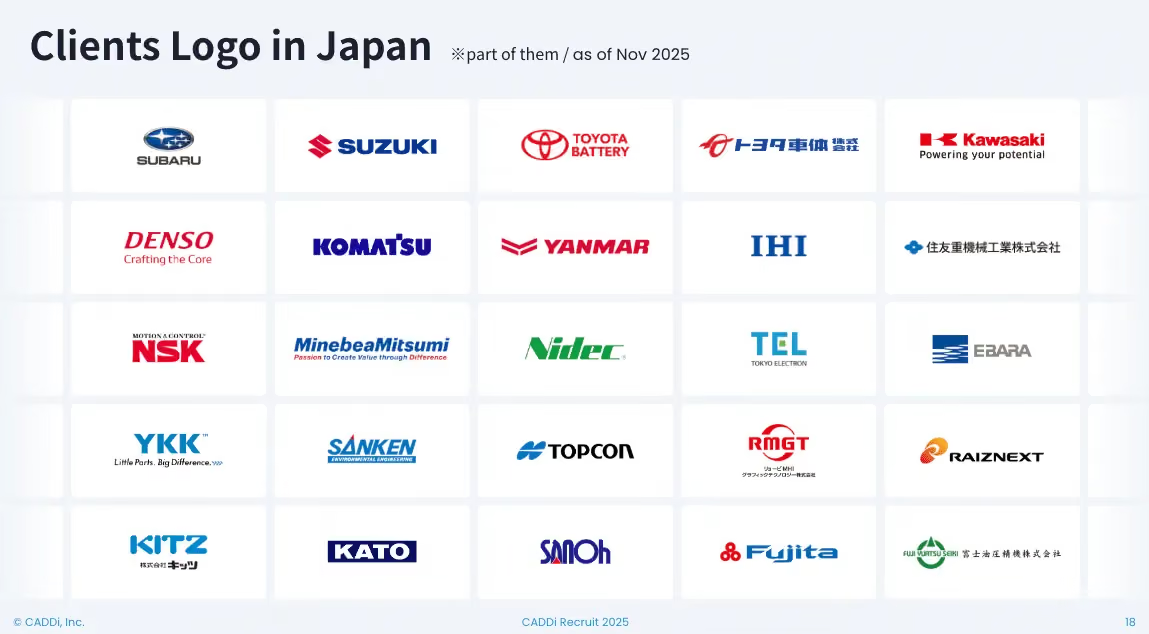
This slide only shows a part of the clients in Japan but we also have many US local clients.
How does CADDi ensure employees will gain the global and new markets expertise that is essential for their roles?
Ryota: One final question: What positions are we hiring for, and are there global transfer opportunities?
Yushiro: We are hiring for basically everything: BizDev, Customer Success, Sales, Marketing, Corporate (HR, Hiring, Accounting), and Engineering.
Regarding transfer opportunities: Yes. We have about 50 employees in the US, and some have transferred from Japan. Recently, I asked on my Slack channel, "Is there anybody who wants to go to the US?" More than 10 people said yes. I picked one, and he is moving next month. It's that casual. If you are performing well, the opportunities are there. We are also expanding into Europe and other parts of Asia, so naturally, there will be more global transfer opportunities.
Ryota: Great. We need to expand our team, and we are in the phase of building a strong team here in the US. It should be a very exciting opportunity.
CADDi continues to grow and is seeking global talents across different specialties and experience levels. Check out our careers page for open positions in the US and Japan.
In December 2025, we hosted an exclusive webinar for MBA students moderated by CADDi CFO Ryota Haga, who was joined by our CEO Yushiro Kato and Atomico's Luca Eisenstecken.
We discussed how the rules of the game for high-growth startups have changed in the AI era, the specific edge CADDi holds in the manufacturing industry, and the global career opportunities empowered by this new era.
While this event was held as a closed session, we are pleased to specially release a portion of the panel discussion to share the insights discussed on the day.
Panelists
- Yushiro Kato (Co-founder & CEO at CADDi)
- Luca Eisenstecken (Partner at Atomico)
- Ryota Haga (CFO at CADDi / moderator)
How has the high-growth playbook changed in the AI era?
Ryota: We see a lot of buzzwords in AI, and we started to see players experiencing exponential growth in this area. The growth period has changed a lot from the past standard. From your perspective, Luca, how has the high-growth playbook changed in this AI era?
Luca: It's a great question. It's something that we're grappling with and thinking about every day. I have a slightly different view than what you would probably read day-to-day.
The rules of the game have changed. That is undeniably true. We are seeing growth trajectories that even two years ago would have been impossible to achieve. It's unprecedented growth. That being said, there's always more than meets the eye.
What I’m spending a lot of time trying to unpack is the quality of that revenue and the durability of that growth.
While some of these trajectories look mind-bogglingly good, it's always a question of what actually underpins that. The access you have now means you can do more with less. That is incredibly exciting, and if you're not leveraging that, you will lag behind. Also, the solutions have become different. If you are not AI-native, or layering AI-native solutions on a traditional B2B software business, you will likely have a hard time selling in the future because you're competing with founders that are incredibly hungry.
However, what has mainly changed is the velocity and the attention we're paying to what is actually driving adoption. Two or three years ago, if you sold a contract, there was not a doubt that usage and ROI were there. Now, we're seeing a lot of experimentation and budget unlocking because corporations just "want to be AI."
Therefore, what matters much more now is the underlying usage and actually measuring ROI. You have to identify the pain points you're solving and differentiate from several other solutions coming up.
What has me so excited about CADDi is the value delivered every day across departments, the usage in accounts, and the retention metrics. It’s the underlying quality of revenue while still delivering outsized growth. That combination is exceedingly rare and historically has not been possible. If you seize that, that is where a generational opportunity awaits.
Should we rethink the role of AI and Software Tools for Business Growth?
Ryota: As you said, it's really hard for companies that are not AI-native to survive. Meanwhile, there is a huge opportunity to utilize existing AIs internally to do more with less. Yushiro, what's your perspective on this?
Yushiro: This is a really interesting era. AI matters, but for me, at the same time, AI doesn't really matter. AI is just one of the enablers.
There used to be terms like "T2D3" (Triple, Triple, Double, Double, Double) for SaaS growth. Now it's like "Q2T3"—Quadruple, Quadruple, Triple—growing from $1 million to $100 million within three years. You’re surviving in an era of speed.
But we haven't changed the plan. We have been an AI-native company long before ChatGPT-3 launched. With CADDi Manufacturing*, we used a lot of AI to automatically recognize the shape of parts, understand customer requirements, and select suppliers.
*CADDi’s original business, a platform for delivering custom-made parts ordered by customers with optimal QCD (Quality, Cost, Delivery)
The core thing, as Luca said, is the quality of the revenue. We are taking a close look at the churn rate and NRR (Net Revenue Retention). There are a lot of LLM wrappers out there, and it's easy to create those. But the thing that hasn't changed is that growth should be driven by customer needs and deep customer understanding. You should not start from AI or technology; you should start from the market.
However, AI has made unsolvable issues solvable. In manufacturing, issues like shortening engineering lead time, reducing procurement costs, and improving quality impact the P&L and Balance Sheet directly.
Another important change is the budget shift. Traditionally, software was bought with an IT budget. Now, accountability has shifted to the business' budget because AI software, like CADDi, can impact the real P&L.. We have customers where procurement teams, who have never bought software before, are buying with their own budget.
I think we should take a look at what hasn't changed rather than what has. The world will change fast, but the key question is what will remain unchanged for the next 5-10 years.
How do you assess "Quality of Revenue"?
Yushiro: One question to Luca—how do you assess the quality of revenue? It's really hard to identify the difference between a simple wrapper and a deep solution.
Luca: It's both qualitative and quantitative. On the quantitative side: renewal cycles, Gross Revenue Retention, and Net Revenue Retention. Do people renew? Do they expand?
We then go a level deeper: Usage. How often do they use it? How does it correlate to their workflows? It's like the classic NPS question: "If CADDi ceased to exist tomorrow, how would you feel?"
When I looked at CADDi, I spoke to many customers and experts. Understanding how it gets adopted is a massive indicator. We also look at the gross margin profile—are you giving things away to drive usage?
When we pull all of that together, the Venn diagram of "high quality of revenue" and "durability of growth" is very small.
What is CADDi’s Edge in this AI age?
Ryota: What is CADDi's edge? There are so many companies saying, "We are AI-native." How is CADDi different?
Luca: In short: Real, tangible ROI. You're solving huge structural problems that haven't been solvable before. These problems are the largest markets I've seen in the last 10 years.
If you have tangible ROI, and you are ingrained in the permission level of companies and data workflows, you have data gravity as a result of usage. That is an edge because you have access to things others don't. No matter how much someone may try, if you're not integrated within the parameters of permission, you cannot solve it.
The second edge is your team and ambition. You have a relentless pursuit to be a global business—winning in Japan, Southeast Asia, now expanding to the US. Having a technical edge is hard, but without the ambition to execute, it doesn't matter.
Yushiro: I would highlight two main areas. The first is our technical edge, specifically regarding shape recognition. Since the core data of manufacturing lies in design data—drawings and 3D CAD—we leverage our own proprietary technology to recognize and analyze these shapes. To give an analogy, while generic AI can beat humans at Chess or Shogi, it often struggles with specific mate problems because they require deep, specialized logic. There is still a huge gap between verticalized, specialized AI and generic AI, and since manufacturing is one of the deepest industries, our unique shape analysis capability is a critical edge.
The second is our organizational strength backed by domain knowledge. We are not just a software company; we started by handling physical products like sheet metals and machining. I personally handled quotations, supplier development, and inspections, and even apologized to customers for quality defects. This experience means we understand the real value chain from engineering to the aftermarket. While generic AI can solve surface-level issues, our deep understanding allows us to tackle the deeper, structural issues that others cannot reach.
What is CADDi's strategic leverage for U.S. market expansion?
Ryota: What unfair advantage led you to bet on CADDi in the US, given that Japanese firms often struggle to scale globally?
Yushiro: We never viewed this as "Japan vs. Global." We need to acknowledge that "Japan is part of Global." Our mission doesn't say "support Japanese manufacturers"; we are born global.
Our unfair advantage is that we have been doing real manufacturing for more than 7 years. We supported engineers with drawings because we were liable for the quality and cost of the parts we manufactured. We sourced parts from 600 suppliers globally and had several physical inspection centers. We have a deep understanding of the real world—like excess inventory issues—that pure software vendors don't have.
Also, drawings are a universal language. Manufacturing is language-agnostic. Our shape analysis technology is universally applicable.
Luca: It seems impossible until someone does it. Atomico was founded by the founder of Skype. 20 years ago, people said, "You cannot build a tech giant from Europe." He proved them wrong. Now, 40% of large US successes are non-US founders (such as Datadog, UiPath, Stripe). Great founders and companies can be built from anywhere. You guys are the living example of a Japanese-originated breakout company becoming a global success.
What is your approach to convince American manufacturers to choose CADDi?
Ryota: Another question: What is the strategy to acquire American accounts?
Yushiro: Actually, our portfolio in the US is quite diverse. We are already serving huge US manufacturing enterprises, as well as local job shops. It is certainly not limited to Japanese subsidiaries.
To acquire these customers, the strategy is simple but hard: In-person, On-site touchpoints. Even in this virtual era, we visit their factories, attend trade shows, and talk to CXOs and VPs face-to-face. Since customers upload proprietary data like drawings and costs, emotional credibility is essential.
This slide only shows a part of the clients in Japan but we also have many US local clients.
How does CADDi ensure employees will gain the global and new markets expertise that is essential for their roles?
Ryota: One final question: What positions are we hiring for, and are there global transfer opportunities?
Yushiro: We are hiring for basically everything: BizDev, Customer Success, Sales, Marketing, Corporate (HR, Hiring, Accounting), and Engineering.
Regarding transfer opportunities: Yes. We have about 50 employees in the US, and some have transferred from Japan. Recently, I asked on my Slack channel, "Is there anybody who wants to go to the US?" More than 10 people said yes. I picked one, and he is moving next month. It's that casual. If you are performing well, the opportunities are there. We are also expanding into Europe and other parts of Asia, so naturally, there will be more global transfer opportunities.
Ryota: Great. We need to expand our team, and we are in the phase of building a strong team here in the US. It should be a very exciting opportunity.
CADDi continues to grow and is seeking global talents across different specialties and experience levels. Check out our careers page for open positions in the US and Japan.
Ready to see CADDi Drawer in action? Get a personalized demo.
Subscribe to our Blog!
.svg)
.svg)
.svg)